You need a sales tax permit before you can collect sales tax in any state where you have nexus. Registration is usually free and fast online, but once you're registered, you must file returns on the schedule the state assigns, even when you owe nothing.



If you have enough economic or physical connections within a state, you establish nexus and must collect sales tax on taxable sales.
You can't just start collecting sales tax, though. You have to register and obtain a sales tax permit, or a seller's permit, first.
Sales tax or seller's permits go by different names in different states. But whether you get a seller's permit in California, a Sales and Use Tax permit in Texas, a Certificate of Authority in New York, a Vendor's License in Ohio, or a document with some other name, the purpose is the same.
You must register to get permission from the state to collect sales tax on the state's behalf. Without it, most states prohibit collecting sales tax, even if you fully intend to remit what you collect.
Once you have registered, you may have to file sales tax returns even if you have a zero-sale period and don't owe any tax. Because compliance obligations continue until you've closed your sales tax account, you typically want to register only when you have to or benefit from doing so.
This guide explains sales tax and seller’s permits and provides insight into whether you're required to register, what documents you need to do so, the registration process (including costs and timelines), and what to do if you're late to register.
[inline-cta title="Let us worry about sales tax." text="The trusted solution for U.S. sales tax, VAT, and GST compliance, used by 3,000+ global businesses. " button="Get started for free" button-link="/get-started"]
When you establish nexus, you are expected to act as a tax collector for the state. You must collect money from customers and hold it in trust until you remit payment to the state.
This is a serious obligation, so you must register or obtain a permit to collect this tax on the state's behalf.
However, because states call the tax they charge on goods and services by different names, and each state can set its own sales tax rules, there's substantial variation.
For example, in Arizona, customers don't pay a standard sales tax. Instead, Arizona's tax is a transaction privilege tax. This is a tax on the vendor for doing business rather than a consumption tax on the buyer, but vendors often pass the cost on.
New Mexico and Hawaii also have unique tax rules, including a gross receipts tax in New Mexico and a general excise tax in Hawaii. These taxes often apply to a broader range of goods and services, and merchants pay the taxes but pass the cost to consumers.
As a result, most of the variation in sales tax permits is semantic. States may call a sales tax permit by a different name, but it accomplishes the same thing. It gives you authority to act as a tax collector. States commonly refer to the document granting this permit as:
What makes this confusing, however, is that if you establish nexus in different states, you'll have to complete each state's registration process. So you may hold lots of permits, licenses, and certificates for just your single company.
A sales tax permit accomplishes a single specific thing: It gives you authority to collect sales tax (or the state equivalent).
Unfortunately, sellers often confuse it for other tax certificates or licenses you may need to do business in a state. Some of those other documents include:
Since you typically don't want to register unless you're required to, it helps to know exactly when each state's registration requirements kick in. Ultimately, four key factors typically determine whether you must register—and it all starts with nexus.
You establish economic nexus if you have sufficient economic connections with the state, typically defined as a certain volume of sales or number of transactions. You establish physical nexus if you have a local presence, such as an office, warehouse, or employees.
Once you establish nexus, you're required to collect and remit sales tax on taxable sales and could face an audit and penalties if you don't.
States have jurisdiction over you (and the authority to order you to do things) once you have sufficient connections with the state. There are two primary types of nexus:
The table below shows an example of some of the requirements for establishing nexus in several states. You can see a full breakdown of nexus thresholds by state here.
Establishing nexus means you have an obligation to collect and remit sales tax on taxable items. But in some cases, the items you sell are not taxable. And this affects your obligations.
In Texas, for example, the Comptroller's website says you need a sales tax permit if you engage in specific types of taxable activities, as the screenshot below shows.
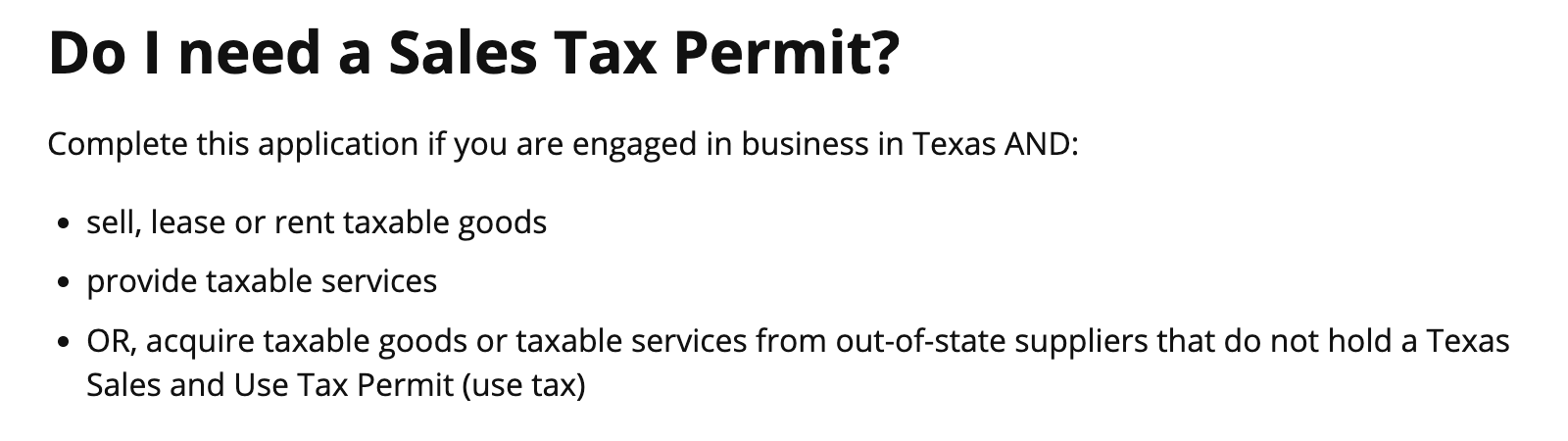
Items that are not taxable can still count when determining whether you meet nexus requirements.
So, in some states, you won't need to register if all your items are exempt, but in others, you may need to register even if you'll ultimately have no collection obligations.
Make sure you understand the state's rules for when and if exempt transactions count. This matters because many states exempt items like groceries and clothing.
States also vary widely on whether they tax SaaS and digital goods.
This is one place Numeral can help. We track each state's rules for nexus, including which items count in calculating whether you've hit the threshold, and offer free nexus monitoring.
[inline-cta title="Let us worry about sales tax." text="The trusted solution for U.S. sales tax, VAT, and GST compliance, used by 3,000+ global businesses. " button="Get started for free" button-link="/get-started"]
Many sellers offer taxable items for sale on a marketplace, so marketplace facilitator laws apply.
In the United States, Washington, D.C., and every state that charges sales tax has marketplace facilitator laws in place that change sales tax rules.
Under marketplace facilitator laws, third-party marketplaces that play an active role in facilitating a sale must collect sales tax for all on-platform sales. Examples include Amazon, Etsy, eBay, and Walmart.
If a marketplace collects tax for you, this doesn't necessarily eliminate your obligations to register in a state. On-platform sales may also count toward determining whether you meet the registration threshold. So, you may need to register even if you don't collect and remit sales tax.
Rules differ by state, so it is important to understand local requirements. For example, here are the rules in four major locations:
Because most states count marketplace sales when determining whether you meet the economic nexus threshold, it's important that your company track these sales and understand the registration rules in any location where you do business. Here's an example:
Numeral's free nexus monitoring can connect to all of your different sales channels, including marketplaces, and track total sales across all sources. You'll be alerted when you're approaching the nexus threshold and when you've crossed it.
Numeral can then autoregister and file and remit on your behalf. Registration is just $150 per state and filing is $75 per return with no long-term commitment required. Every return is reviewed by a U.S.-based tax expert before submission.
In some states, once you cross the nexus threshold, you have a grace period before you must register and start collecting sales tax.
For example, a remote seller in Texas must obtain a sales tax permit no later than the first day of the fourth month after exceeding the $500,000 registration threshold. Other states have different rules, and some even require pre-registration.
New York, for example, requires you to apply for a Certificate of Authority at least 20 days before you start operations and prohibits you from making a taxable sale until you've been issued your certificate of authority.
New Jersey requires filing NJ-REG at least 15 business days ahead.
Rules also differ depending on whether a local business must register or a remote seller does. So, before you begin doing business in any new location, make sure you understand the registration obligations and timeline so you don't fall out of compliance.
If you get your registration timing wrong, your company could face financial loss in multiple ways, depending on the error:
Penalties are substantial because sales tax revenue belongs to the state. You are responsible for collecting and remitting payment, but you act as an agent of the government, and you must hold the money in trust until you pay it.
While the process varies by state, there are common requirements for applying for a sales tax or seller's permit. The process typically takes 15 to 30 minutes if you have your documents ready before you begin.
Generally, you will need:
Some states have significantly more burdensome requirements than others. For example, CDTFA Publication 73 also requests personal references, supplier names, merchant credit card processor details, and your bookkeeper's contact information.
Some states also require a deposit or security when you register, beyond the upfront registration fees. For example:
There are two processes you can potentially use to register for sales tax. You can either register with each state directly or use the Streamlined Sales Tax system to register for multiple participating states with a single, simple application.
Here are the steps to take to register directly with a state:
The Streamlined Sales Tax Registration System is an alternative to registering individually in every state, and it can significantly simplify the sales tax registration process. Registering with SST can fulfill your registration obligations across nearly half of the United States.
A total of 23 states are full member states, while Tennessee is an associate member. You can use SST to register to collect sales tax in any or all of these states with one free application.
Qualifying sellers who register through SST and who contract with a Certified Service Provider are also eligible for tax calculation, filing, and remittance at no cost in member states, because the states pay the provider. Eligibility depends on a property, payroll, and fixed location test.
You may be eligible for free tax support from a CSP if you have:
Many ecommerce merchants are entitled to free tax support from a CSP, including most remote sellers who are only required to collect in a state because they meet the state's nexus threshold.
Unfortunately, some sellers have misconceptions about SST that prevent them from taking advantage of this simplified process. Specifically:
California, Texas, New York, Florida, Illinois, Pennsylvania, and Massachusetts aren't SST members, so you still must register directly in these jurisdictions.
Most states charge nothing to register, though some locations have fees. The timeline for registering also varies by state, as well
The table below shows the costs of registering for a sales tax permit (or the equivalent) and typical processing time by state.
Note that processing times can vary widely. Applications requiring manual review, security deposits, bonds, local approvals, or mailed documents may take longer.
These timelines above are for online applications. If you apply by mail, you can expect the process to take much longer. For example, Michigan says to expect a four- to six-week wait if you submit a paper application, and Illinois six to eight.
While processing times are often short, your company could still spend significant time on registration and managing online accounts, especially if you do business in multiple states.
If you have nexus in 15 states, for example, you would need to visit 15 portals, create 15 logins, and follow up on 15 different timelines. Or you can use Numeral to autoregister you as soon as you establish nexus, for a flat fee of $150 per registration.
[inline-cta title="Let us worry about sales tax." text="The trusted solution for U.S. sales tax, VAT, and GST compliance, used by 3,000+ global businesses. " button="Get started for free" button-link="/get-started"]
Once your sales tax permit is approved, your filing obligations begin. Here's what you need to know about these obligations.
You do not get to choose how often you file. Each state will assign you to file either monthly, quarterly, semiannually, or annually based on estimated tax liability.
Once you begin collecting and remitting, your filing frequency can change based on actual liability.
For example, in Florida, here is how often you are required to file based on tax collected:
States differ in how they inform you of your required filing frequency. For example, California sets the frequency at registration based on anticipated taxable sales, while Texas notifies you by letter after approval.
Many sellers aren't aware of this requirement, but you must file a sales tax return even in a period when you owe no sales tax. If you fail to file the required return, you could still owe penalties even though no tax was due. For example:
In most states, your sales tax permit remains valid as long as you keep your account compliant and you continue to file regularly. However, a minority of states require periodic renewal, including:
Several of these renew automatically, but only if your account is current.
It's important to note that your filing obligation is not permanent. If you stop meeting the state's requirements and are no longer required to collect sales tax in the state, you can close or cancel your account.
You will need to follow each state's cancellation process or the SST process to cancel individual state registrations. But as long as you complete the requirements, you can unregister and no longer be obligated to file or remit taxes.
Unfortunately, some sellers discover too late that they should have registered and begun collecting sales tax many years ago. The problem for these sellers is that the statute of limitations for these past claims often doesn't start running until you file a return. For example:
This means if you have never registered or filed, the state can look back much further than you might expect—and you could have many years of back tax liability.
When you submit your application, every state asks when you started doing local business or made your first taxable sale. This leaves you with two possible outcomes if you're late on registering:
This is a difficult situation, but you do have options, including a voluntary disclosure agreement.
If you were supposed to collect and remit sales tax in the past and didn't, a Voluntary Disclosure Agreement (VDA) may be your best option for resolving your unpaid tax liability. When you create a VDA:
If you have economic nexus in the state, typically the state doesn't apply a rolling three- to four-year lookback period. Often, it looks back to the date when economic nexus rules became effective.
This generally occurred shortly after the South Dakota v. Wayfair case opened up the door to remote nexus. Since this case was decided in 2018, your liability could go back many years (the Multistate Tax Commission publishes these dates by state).
You'll need to consider your timeline in determining what course of action is best. If you have only a small amount of recent exposure, registering with an accurate start date is generally your fastest and cheapest option, even if you owe a small amount of back tax.
However, if you have years of unpaid taxes, especially in multiple states, unpaid liabilities may be significant. In these situations, it's critical to explore a VDA before registering and becoming liable for back tax.
The time and fees involved in negotiating the agreement are often worth it, as the savings can be substantial compared with the full amount of back tax and penalties.
Unfortunately, if you have prior contact with the state related to sales tax, including filing a return, registering, or paying taxes, you may be disqualified.
The MTC Multistate Voluntary Disclosure Program can make negotiating agreements easy, as you can submit one anonymous application to negotiate with up to approximately 39 member states at once, at no charge.
Numeral's free monitoring plan includes an exposure audit that quantifies your historical liability. It can help you understand what you'd potentially owe without the VDA so you can make an informed choice.
Registering for a single state is simple, but the surrounding obligations are anything but. You have to monitor sales in every state where you do business, understand different registration requirements, and register in potentially dozens of locations.
Or you can use Numeral to handle it all for you. Numeral offers:
Book a demo today to see how Numeral can help automate registrations for you or get started on your own.
Still need to know more? Here are the answers to frequently asked questions about sales tax permits.
A seller's permit is the same thing as a sales tax permit. These permits go by many different names, including a sales and use tax permit in Texas or a sales tax license in Colorado, Michigan, and Pennsylvania. Regardless of what it is called, the permit is issued after registration and is required to collect sales tax in the state.
Many states charge no fee to obtain a sales tax permit. In states with a fee, the cost ranges from $12 in Arizona to $100 in Connecticut. Some states, like Colorado, also require a small deposit ($50) that's refunded after you remit $50 or more in tax.
The timeline to obtain a sales tax permit ranges from 15 minutes to four weeks, depending on the state, as long as you submit the request online. Some states, like Georgia and Michigan, provide a sales tax registration number almost instantly, while others, like Texas, require two to three weeks. If you submit a paper application, you can expect it to take four to eight weeks.
If you sell on Amazon or Etsy, those platforms are marketplace facilitators, and they must collect and remit tax for on-platform sales. In many states, you still need a sales tax permit, even if all sales are on the marketplace. After obtaining a permit, you may be able to request non-reporting status.
The rules can differ substantially by state, though. California doesn't require permits for companies that sell only on marketplaces, while Washington requires registration due to a separate B&O tax.
Marketplace sales also count toward the economic threshold in many locations, so if you have even a small amount of off-marketplace sales, you may need to register, file, and remit.
A sales tax permit is different from an EIN. An EIN is a federal tax identifier issued by the IRS, while a sales tax permit is issued by a state to companies with economic or physical nexus who complete registration requirements.
The sales tax permit authorizes a company to collect and remit tax. An EIN may be required to apply for a sales tax permit, but sole proprietors may sometimes use a Social Security number instead.
In most states, sales tax permits remain valid as long as you continue to file and remit and your account is current. A small number of states do require renewal, including Colorado and Connecticut every two years, Pennsylvania every five years, and Arizona, Alabama, Michigan, Rhode Island, and Washington annually. States that require renewal may allow it to occur automatically.
[inline-cta title="Let us worry about sales tax." text="The trusted solution for U.S. sales tax, VAT, and GST compliance, used by 3,000+ global businesses. " button="Get started for free" button-link="/get-started"]
The trusted solution for U.S. sales tax, VAT, and GST compliance, used by 3,500+ global businesses.