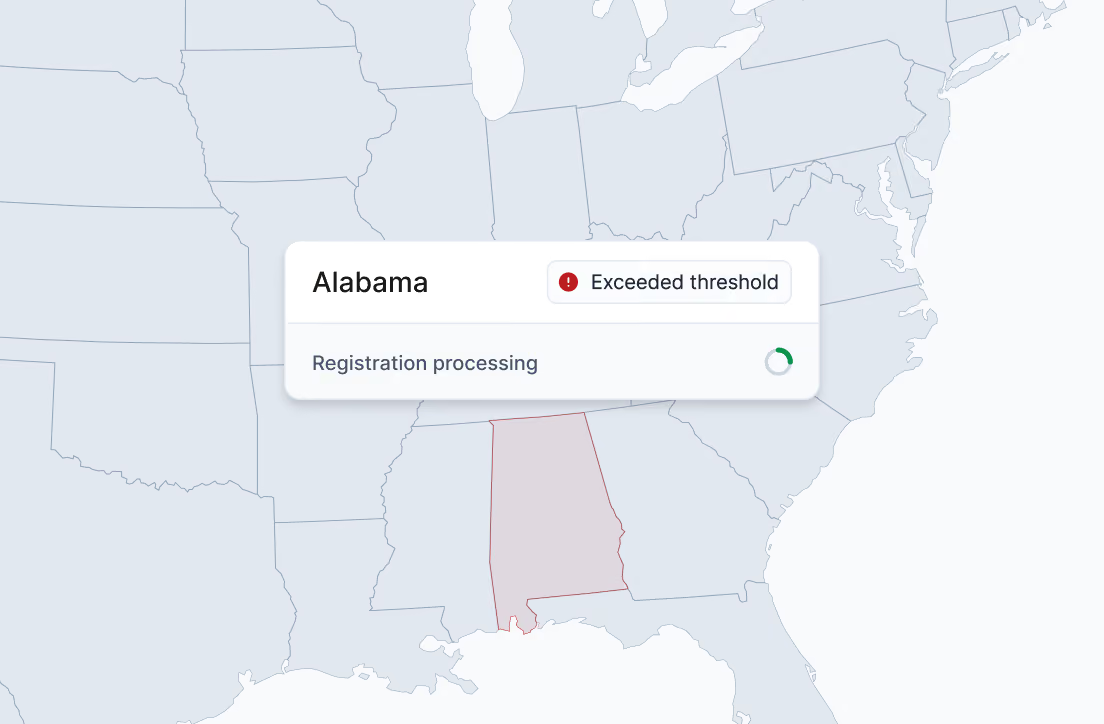
Alabama's economic nexus threshold is $250,000 in sales. Get a free nexus study. All 50 states covered.
Alabama recognizes affiliate nexus when a remote seller and an Alabama-based business share 50% or more common ownership — whether held directly, indirectly, or under IRS attribution rules — and the in-state affiliate performs market-maintenance activities on the remote seller's behalf. Qualifying activities include sharing a trademark or brand name, making payments contingent on the remote seller's Alabama sales volume, operating under a shared business plan, or providing services that benefit the remote seller's Alabama customer base.
When affiliate nexus applies, the remote seller is disqualified from Alabama's Simplified Sellers Use Tax program and its flat 8% rate, and must instead collect the full state and local rate.
Physical nexus in Alabama arises from the first day of in-state physical presence under [Rule 810-6-2-.90.03](Alabama DOR: Sales and Use Tax Rules) and Ala. Code § 40-23-67. Nexus is established by any of the following: maintaining any place of business in the state, even temporarily, including an office, distribution point, sales room, warehouse, storage facility, or trade show booth; employing or retaining any representative, agent, salesperson, canvasser, or installer operating in Alabama; delivering goods into Alabama in a seller-owned or leased vehicle (delivery via common carrier such as UPS or FedEx does not create nexus); or storing inventory in an Alabama fulfillment center, including Amazon FBA warehouses.
Sellers with inventory stored at Alabama FBA warehouses are subject to standard state and local sales tax rates rather than the simplified 8% SSUT rate, because physical nexus disqualifies a seller from the SSUT program.
Alabama has not published a formal trailing nexus policy. For economic nexus, the prior calendar year evaluation period produces a natural one-year trailing obligation: meeting the $250,000 threshold in Year 1 requires collection throughout all of Year 2, after which the obligation is re-evaluated. For physical nexus, the Alabama Department of Revenue has not issued written guidance specifying the duration of the collection obligation after in-state physical presence ends.
Lorem ipsum dolor sit amet, consectetur adipiscing elit. Suspendisse varius enim in eros elementum tristique. Duis cursus, mi quis viverra ornare, eros dolor interdum nulla, ut commodo diam libero vitae erat. Aenean faucibus nibh et justo cursus id rutrum lorem imperdiet. Nunc ut sem vitae risus tristique posuere.

