Massachusetts sales tax registration gets you a Sales and Use Tax Registration Certificate (Form ST-1) from the Massachusetts Department of Revenue. You register online through MassTaxConnect, and DOR doesn't list a registration fee. Remote sellers need to register once their Massachusetts sales top $100,000 in the current or previous calendar year.
You need a Massachusetts Sales and Use Tax Registration Certificate if you sell or rent taxable goods or services in Massachusetts and you're engaged in business there, either through a physical presence or by crossing the sales threshold. You must register before you open.
There is sales tax on most SaaS in Massachusetts, since charges for using software on a remote server are generally taxable.
If you have no physical presence in Massachusetts, you need to register and collect sales and use tax once you cross the Massachusetts economic nexus threshold. That's more than $100,000 in Massachusetts sales in the current or previous calendar year.
Massachusetts has no transaction-count test, so the number of orders doesn't matter.
Count every sale of goods or services delivered into Massachusetts:
Leave out sales a marketplace makes for you when the marketplace collects and remits the tax. Only your direct sales count.
You must start on the first day of the first month that begins two months after the month you cross $100,000. For example, if you cross the threshold in May, you need to be registered and collecting by Aug. 1.
The requirement then carries into the next calendar year, so you keep collecting from Jan. 1. If you crossed after Nov. 1, you start on the two-month date instead, even when it falls after Jan. 1.
If you're under the threshold, you may register voluntarily to collect use tax from your Massachusetts customers.
If you crossed the threshold in an earlier year and never registered, voluntary disclosure can reduce what you owe. Massachusetts' Voluntary Disclosure Program may waive late-file and late-pay penalties and generally looks back 3 years for out-of-state businesses. Interest still applies.
You qualify only if DOR hasn't contacted you about the tax, you aren't registered, and you haven't collected it. You can start the application anonymously in MassTaxConnect.
Any of these gives you a physical nexus in Massachusetts, so you need to register regardless of sales volume:
Sellers with physical presence need the certificate before the business opens. Marketplace-only sellers are covered in the next section.
Massachusetts' marketplace facilitator rules apply to marketplaces with more than $100,000 in Massachusetts sales, counting their own sales and the sales they facilitate. Those marketplaces must register and collect tax for their sellers.
The marketplace gives you Form ST-16, its collection certificate. Once you receive it in good faith from an unrelated marketplace, you don't collect or remit tax on the sales it facilitates.
Whether you still need your own registration depends on whether you have a Massachusetts presence and how you sell:
If you store inventory in a marketplace’s Massachusetts warehouse, as many Amazon FBA sellers do, DOR treats it as an in-state vendor contact. That makes you an in-state seller, not a remote one.
The $100,000 threshold doesn't apply to your direct sales. If you also sell through your own website, you need to register regardless of volume because you have sales tax nexus in Massachusetts. Even if every sale goes through the marketplace, you likely need your own registration.
Businesses register with a Federal Employer Identification Number (FEIN). Sole proprietors register with their Social Security number, and those with employees also provide an FEIN.
Check your city or town's website for a local business certificate and any other local licenses. Those are separate from your state registration.
All businesses except sole proprietorships also need these details for each owner or officer:
The New Business Registration is the same path for:
Massachusetts has no paper application. Every business registers online through MassTaxConnect.
These steps follow DOR's registration instructions for businesses that have never filed Massachusetts taxes.
Open MassTaxConnect, DOR's online system for registering, filing, and paying. Select Sign Up under the login box, or Register a New Taxpayer under Quick Links.

On Registration Options, select Register a Business. That option is for businesses that haven't previously filed or paid taxes in Massachusetts.

You're already in DOR's system, so you register in two parts. First, select Create My Logon, then the option I am an individual who has previously filed taxes in the state of Massachusetts. You'll verify your identity with your Social Security number and details from a past return or a DOR letter.
After you log in, go to More on your Summary page. Under Access, choose Add an Account, New Location or New License and register the business.
The New Business Registration screen lists who can use it and what you'll need. Complete the CAPTCHA and select Next.

Follow the prompts and enter the information from the checklist above:
When you submit, you'll get a confirmation email with an authentication code for your first login.
Warning: DOR can deny a registration if the business, or an officer responsible for its taxes, owes Massachusetts tax that has been finally determined and not paid. Settle any balance before you apply.
After DOR approves your registration, log in to MassTaxConnect. It will prompt you to set up two-step verification by authentication app, text message, or email.
DOR mails a Sales and Use Tax Registration Certificate, Form ST-1, for each business location. It shows your sales tax account ID and certificate number.
To print a copy, log in and choose More, then Letters, then View Letters.
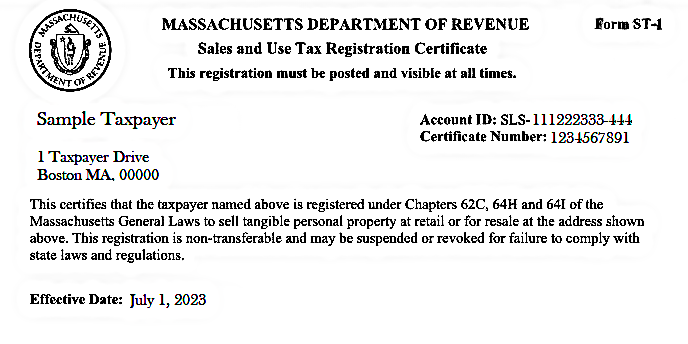
DOR doesn't list a registration fee, and there's no renewal fee.
If you move a location within Massachusetts, DOR reissues the certificate for the new address without an additional fee.
DOR may require a bond to secure the tax you owe. It sets the amount, up to a cap of your average tax liability for six months.
The bond comes from a surety company authorized in Massachusetts. Instead, you can deposit Massachusetts or U.S. bonds or other negotiable obligations with the state treasurer.
DOR hasn't published a processing time for registrations. You get a confirmation email when you submit, and DOR mails the certificate after it approves the registration.
If you sell taxable goods at a show or flea market in Massachusetts, you need your own Sales and Use Tax Registration Certificate. A promoter can't let you sell unless you're registered as a vendor and display your certificate.
Give the promoter your name, address, and vendor registration number. The promoter reports that information to DOR each month a show runs.
Post each certificate where customers can see and read it at that location: at the register, the customer service counter, or the main entrance, depending on the layout.
Out-of-state vendors without a Massachusetts location keep it on file where they take Massachusetts orders.
If you don't display it properly, DOR can suspend or revoke your registration. Reissuing a suspended or revoked registration costs $20.
Charge Massachusetts sales tax of 6.25% of the sales price on taxable sales, and state it separately on invoices and receipts.
Remote sellers start on the date set by the threshold rules above. All other vendors collect from their first taxable sale.
DOR sets your filing schedule by how much sales and use tax you collect in a year:
Remote sellers and marketplaces file monthly. If your cumulative liability topped $150,000 in the previous calendar year, you also make advance payments on monthly returns.
You file Massachusetts sales tax returns on or before the 30th day after the end of each period. Payment is due with the return.
New businesses must file and pay electronically through MassTaxConnect. You must also file a return for every period, even when no tax is due.
DOR doesn't currently require you to renew the certificate. It shows an effective date but no expiration date, and it can't be transferred to another owner.
To close a location or cancel the registration, use your MassTaxConnect account or mark your last return as final.
Registration rules differ by state, and several require regular renewal.
No. An EIN, or FEIN, is a federal tax ID from the IRS. Your Massachusetts registration is DOR's authorization to collect sales tax, and it comes with its own sales tax account ID.
It depends. A sole proprietor without employees registers with a Social Security number alone. Other businesses, including sole proprietors with employees, need an FEIN.
A foreign (non-U.S.) business that can't get an FEIN should call DOR at (617) 887-6367 for help registering.
Yes. DOR issues a registration for each place of business. To add a location later, log in and choose Add an Account, New Location or New License.
No. Form ST-1 shows you're registered to collect sales tax. When you buy goods to resell, you give your supplier Form ST-4, the resale certificate, instead.
An ST-1 isn't a substitute for an ST-4. Suppliers who receive your ST-4 can check your registration in MassTaxConnect.
It depends on whether you have a physical presence in Massachusetts.
If you also sell through your own website, those direct sales count. Without a presence, you need to register once they top $100,000 in the current or previous calendar year. With a presence, you need to register regardless of volume.
Yes. If you change your type of legal organization, such as from a sole proprietorship to a partnership, cancel the original registration and register again under the new structure.
The same goes for buying an existing business, since a registration isn't assignable to a new owner.
Numeral is an end-to-end sales tax compliance platform for ecommerce and SaaS businesses. Top brands like Ridge, Muddy Bites, Graza, and Grüns spend less than five minutes a month on sales tax.
Learn more
