Wholesalers don't typically charge sales tax to resellers, but they face compliance issues if they don't verify that buyers are legitimate resellers with valid resale certificates. Learn about obligations of both wholesalers and resellers.



In the U.S., sales tax applies only to the end user, or those who use or consume the finished product.
As a result, sales tax is only charged on the final retail sale and wholesalers don’t charge sales tax if the buyer has a valid resale certificate.
Here's how wholesale sales tax works:
While there's some regional variation, this is the general process. It avoids tax pyramiding, as sales tax is paid only once, unlike in VAT systems, where companies pay input VAT when buying goods and services and deduct eligible input VAT from output VAT charged to customers.
This guide explains why wholesalers usually don't have to collect tax from resellers, how resale certificates work, how wholesalers and retailers can fulfill their tax obligations, and what to do when problems happen.
[inline-cta title="Let us worry about sales tax." text="The trusted solution for U.S. sales tax, VAT, and GST compliance, used by 3,500+ global businesses. " button="Get started for free" button-link="/get-started"]
A wholesale sale is one made to a reseller, not an end user or consumer. The sale could be made by a manufacturer directly, or by a distributor or other middleman. And typically, but not always, the sale is made to a retailer.
For sales tax purposes, the key issue is not whether the seller defines themselves as a wholesaler. Instead, it is whether the buyer is the end consumer or someone who plans to resell the item. For example, as the Alabama Department of Revenue explains:
"Wholesale sales are sales of tangible personal property to licensed retail merchants, jobbers, dealers, or other wholesalers for resale. It does not include sales to users or consumers that are not for resale. Retail sales are sales of tangible personal property to consumers."
That's why you can have wholesale clubs that sell directly to consumers, like Costco or Sam's Club, but the sales those clubs make are still treated as normal taxable retail sales. While the "wholesaler" may sell bulk products, the products are sold to the end user.
It's also worth noting that a wholesale sale does not necessarily involve selling a product that will be resold in its existing form. The Washington State Department of Revenue defines a wholesale sale as:
"A sale of tangible personal property (including articles you produce or manufacture) to a business or person who will resell the articles in the regular course of business or incorporate the article into another product that will be sold."
Whether the item is incorporated into another product or sold directly, the common trend is that someone down the line is the ultimate consumer and thus responsible for sales tax.
Wholesalers don't charge tax in the U.S.
While global VAT systems charge value-added tax at each step of the supply chain, based on the value added, sales tax in the U.S. is a different system, with items taxed at the point of consumption. Tax is only paid by the consumer at the final sale.
However, a wholesaler can avoid charging tax only if the buyer is not the end user and the tax will be charged further down the supply chain. This is something you have to confirm if you’re a wholesaler.
That's done by ensuring the wholesaler collects a valid resale certificate—a type of sales tax exemption certificate—from the buyer before the time of sale.
A valid resale certificate proves the buyer is registered to collect sales tax, will resell the item, and will collect the sales tax at that time.
Without a valid resale certificate, a wholesaler should treat the sale as a taxable transaction to avoid being liable for unpaid tax. The table below shows how this works.
Wholesalers cannot assume every transaction is exempt, even transactions with resellers. A wholesaler must charge tax if:
If the wholesaler doesn't have a valid resale/exemption certificate on file and doesn't collect tax, the wholesaler may become liable for the uncollected amount. Resale certificates must be provided during an audit to avoid liability.
Failure to comply is risky, as collecting unpaid sales tax from buyers later is often not possible. The practical effect is that the wholesaler would have to pay unpaid tax directly.
[inline-cta title="Let us worry about sales tax." text="The trusted solution for U.S. sales tax, VAT, and GST compliance, used by 3,500+ global businesses. " button="Get started for free" button-link="/get-started"]
A resale certificate is a document that a buyer provides to a seller, certifying that the goods are being purchased for resale, not for consumption.
For example, Massachusetts's definition is similar to those in many other states. It is a "certificate prescribed by the Commissioner, certifying that taxable services or tangible personal property are purchased for resale in the regular course of business."
Massachusetts also explains its rule, which is very similar to the rules in other states:
"A resale certificate relieves a vendor from the burden of proving that a sale of tangible personal property or taxable service is not a retail sale only if the vendor accepts the resale certificate in good faith from a purchaser who is engaged in the business of selling tangible personal property or taxable services, and who, at the time of the purchase, intends to sell the tangible personal property or taxable service in a retail sale in the regular course of business"
The resale certificate must contain key information, including the purchaser's name and address and the purchaser's sales tax registration number. As New York's instructions for obtaining a resale certificate explain, purchasers can use these certificates only if:
Registering as a sales tax vendor and obtaining a sales tax permit are prerequisites. Once registered, a business must file and remit sales tax. Registration may be optional, or required if the seller has established an economic or physical nexus.
The table below shows the different types of documents involved:
Some states allow wholesalers to accept a blanket certificate covering all future purchases from a specific buyer, so the wholesaler does not need to obtain a new certificate for each purchase. Maryland provides an example.
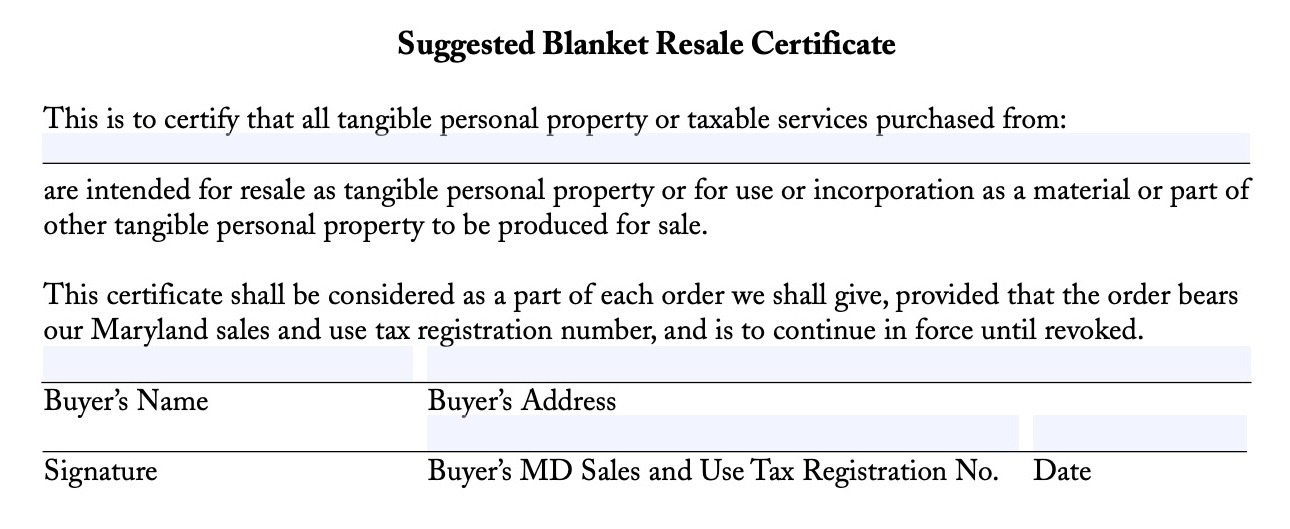
However, it's important to ensure the certificate is valid and monitor when it expires. You can learn about when sales tax exemption certificates expire here.
Numeral’s Exemption Certificate Management software verifies and stores resale certificates and other types of exemption certificates, helping you stay on top of them in less time while remaining audit-ready.
Wholesalers must ensure they follow the appropriate process to accept a resale certificate correctly.
If you can't complete the required steps, you should treat the sale like a normal retail sale and collect sales tax.
Follow these steps to accept a resale certificate correctly and avoid charging tax to the reseller:
Most states require sellers to collect the certificate in a timely manner. Definitions may differ slightly by state, but in California, for example:
"A certificate will be considered timely if it is taken at any time before the seller bills the purchaser for the property, or any time within the seller's normal billing and payment cycle, or any time at or prior to delivery of the property to the purchaser."
Wholesale sellers can avoid tax liability when selling to retailers who provide a resale certificate, but only if they are acting in good faith. Verifying the seller's permit number is a clear sign of acting in good faith. As the Washington State Department of Revenue states, "You should verify your customer reseller permit information at least once each calendar year.”
You can use our state-by-state guide on verifying resale certificates to confirm that the sales tax permit is valid. Confirming the validity of the permit number is essential to doing your due diligence.
Resale certificates can only be used when the buyer intends to resell the specific goods being purchased. Sellers have the obligation to make sure the certificate covers a sale before allowing the sale to be completed without collecting tax
As Connecticut's rules explain:
"Confirm the certificate covers the type of goods being purchased: The retailer cannot accept a resale certificate if the retailer has reason to believe that: 1. the issuer does not ordinarily sell the types of goods or services purchased, or 2. the goods or services will not be resold."
Connecticut gave an example of an auto body shop that purchases a computer. The computer seller can't accept the auto body shop's reseller certificate because the auto body shop isn't likely to resell the computer in its ordinary course of business.
The required retention period varies by state. For example:
The local Department of Revenue in states where you have nexus can help you understand how long you must keep certificates you collect.
Buyers also have certain compliance obligations to fulfill to be eligible to purchase items without paying sales tax. Here is a checklist of what buyers must do.
You must register to collect sales tax in order to be eligible to request a resale certificate.
You typically must be registered in any state where you have physical nexus (an in-person presence) or economic nexus (exceeding a certain volume or value of sales threshold in the state).
If you wish to buy items tax-free from a seller in a state where you would not otherwise be required to register, you'll need to determine if sellers in that state accept resale certificates from different jurisdictions. Otherwise, you may have to register locally, or the sale will be taxable.
Most states accept valid out-of-state resale certificates, often via the Multijurisdictional Uniform Sales & Use Tax Certificate or Streamlined Sales Tax forms, as long as you include your home state's tax ID.
However, a minority of states do not, and require you to obtain an in-state resale certificate to buy tax-free from local sellers for resale. Examples include California and Florida.
You must complete the relevant state's form, providing the requested information. The specifics can vary by state, but you usually must provide your valid tax ID, as well as a description of your business activity and the goods sold.
You may complete a blanket resale certificate to keep on file with suppliers who you work with regularly so you don't need to prepare a new certificate each time. Just make sure you monitor when your certificate is expiring so you can update on schedule.
You are expected to use a resale certificate only for goods you plan to resell. If you misuse the certificate, you can face legal consequences.
For example, the California Department of Tax and Fee Administration states that "Purchasers are subject to penalties and interest for the misuse of a resale certificate. Intentional misuse of a resale certificate can result in criminal prosecution."
It's important to be aware of specific rules that can affect whether an item was "resold" or not. For example, in some states, if you run a Buy-One-Get-One Promotion, the item you give away is treated as a promotional item consumed by you, so you would owe the sales tax on that item.
You must have a valid resale certificate on file for every tax-free purchase of a taxable item. Keeping these certificates on file can protect you in the event of an audit. It should note the supplier and the date.
As mentioned above, a resale certificate from your home state is not necessarily valid in every state. However, the Multistate Tax Commission offers a resale certificate that is accepted by 36 states.
The MTC is an intergovernmental state tax agency that aims to simplify sales tax compliance. Participating states use standardized forms and often incorporate model rules, making it easier for businesses to comply with tax requirements across multiple jurisdictions.
You can find a list of states that accept the MTC certificate on the form itself, or in our state-by-state guide to multi-state resale certificates. Because the list of participating states can change over time, confirm that the state you are buying goods from still accepts the uniform resale certificate before purchasing.
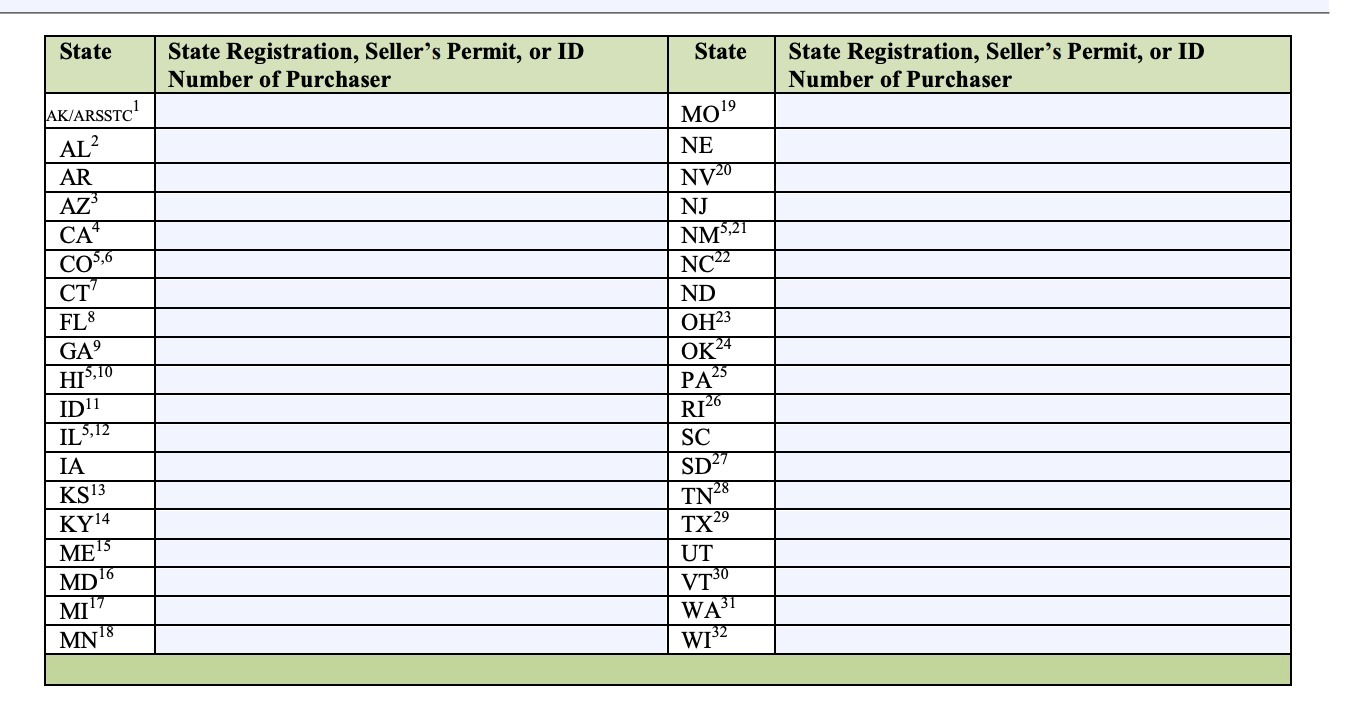
The certificate requires you to certify that you are a reseller registered for sales tax in at least one state and provides space to list your registration, seller's permit, or ID (if available) for each of the 37 participating states.
You do not need to be registered in all the states to use the certificate.
Using this form can simplify your compliance obligations.
Remember that resale certificates, including blanket certificates, may only be used to purchase items for resale. If you are purchasing items both for your company's use and for resale, you cannot treat the entire sale as tax-exempt.
This is a frequent audit trigger and one you should avoid by paying the correct tax upfront for non-exempt items. If you later consume items you expected to resell, you should also address this issue by self-reporting and paying use tax after it becomes clear the items won't be resold.
Buyers with large volumes of mixed-use purchases may qualify for a direct pay permit instead.
It is important to avoid compliance errors that could put you at risk in the event of an audit. Both wholesalers and buyers face unique risks, including the following.
For wholesalers, the biggest risk is allowing tax-exempt transactions without having valid resale certificates (or other exemption certificates) on file for each sale. If you do not collect and store the certificates, or do your due diligence to ensure they are valid, you face significant risk.
Your company can be liable for all uncollected sales tax, as well as penalties and interest, on sales that you improperly treated as tax-exempt.
You generally cannot go back to customers to collect the unpaid tax after the sale, so you will be required to cover the cost out of your pocket.
Buyers who misuse resale certificates also face serious risks. If you use a resale certificate to purchase taxable items in a tax-exempt transaction and do not resell the items, you could owe the unpaid tax, interest, and penalties.
In some cases, you could also be charged with a crime for certificate fraud. And a pattern of misuse could result in your seller's permit being revoked.
Dropshipping adds an extra step to the typical retail transaction. Instead of buying inventory, storing it, and then shipping it to end users, retailers take a customer's order and forward it to a supplier, which then ships the product directly to the customer on the retailer's behalf.
Although the reseller never physically takes possession of the item, their purchase from the wholesaler is still considered a sales transaction.
This means the dropshipper must provide a valid resale certificate to buy the item tax-free, or pay sales tax if they don’t have one. They must also be registered to collect sales tax and (usually) collect it from the final buyer.
If the reseller cannot provide a valid resale certificate, the supplier should collect sales tax on the sale it makes to the retailer. The supplier risks being treated as the retailer in these situations and, if it doesn't collect the sales tax due, is liable for covering it out of its own pocket.
For example, a toy seller who uses dropshipping will list a toy on its website. When the toy sells, the toy seller will request the wholesaler to mail the toy to the customer. The wholesaler is selling the item to the toy seller, who sells to the customer.
If the toy seller does not provide a valid resale certificate, the wholesaler must collect sales tax from the toy seller before shipping the product. If the wholesaler fails to provide a valid resale certificate or collect the tax, the wholesaler may be responsible for unpaid tax on the items.
If everyone follows the rules, however, the final buyer (the consumer) is the only one who pays the tax.
As you can probably tell by this point, wholesalers and resellers face challenges in sales tax compliance.
If you’re in this boat and want to offload your sales tax headaches, check us out here at Numeral.
We offer exemption certificate management that makes verifying and tracking certificates easy. On top of that, we offer:
All of our services are backed by the Numeral Guarantee. If we make a mistake, we cover the penalties, fees, and interest.
Get started or book a demo today to find out how you can manage your compliance obligations in as little as five minutes a month, whether you are a wholesaler, a direct shipper, or a reseller.
Still need to know more? Here are the answers to some frequently asked questions about wholesale sales tax.
Wholesalers do not have to collect sales tax on orders made to resellers with a valid resale certificate. If the wholesaler does not obtain a valid resale certificate or does not do its due diligence to ensure a certificate is valid, the wholesaler can be responsible for uncollected tax.
A wholesale license is not the same as a tax exemption. A wholesale license, or sellers permit, allows a seller to collect and remit sales tax, while a resale certificate allows a qualified reseller to purchase items tax-free for resale. A seller's permit is required to obtain the resale certificate used to qualify for a sales tax exemption.
If you buy wholesale for personal use, you must pay sales tax. A purchase made from a wholesaler is tax-exempt only if the purchase is made by a reseller with a valid reseller permit and if the items are being purchased to be resold. The reseller must then collect the sales tax from the end user or consumer.
You cannot use one resale certificate for suppliers in every state. A majority of states accept the Multistate Tax Commission's uniform resale certificate, but not all. You may need to provide a state-specific resale certificate and, in some cases, be registered for sales tax in that state to make a tax-exempt purchase for resale there.
If a wholesaler does not collect and verify a resale certificate, the wholesaler must charge tax on the sale. If the wholesaler doesn't do so, the wholesaler can be held responsible for the uncollected tax.
Dropshippers should charge tax on wholesale orders unless the reseller provides a valid resale certificate and the dropshipper confirms its validity. If a dropshipper does not have a valid resale certificate on file, the dropshipper should charge sales tax and can be treated as the retailer responsible for collecting and paying the tax if they fail to do so.
[inline-cta title="Let us worry about sales tax." text="The trusted solution for U.S. sales tax, VAT, and GST compliance, used by 3,500+ global businesses. " button="Get started for free" button-link="/get-started"]
The trusted solution for U.S. sales tax, VAT, and GST compliance, used by 3,500+ global businesses.