Washington, D.C., has its own sales tax system, with a tiered rate structure. If you sell to D.C. customers online or in person, you must comply with local laws, including filing and remitting taxes. This step-by-step guide shows you how to file sales tax in Washington, D.C.



Throughout the United States, sales tax rules vary by location. Washington, D.C., is one of those locations. Specifically, the Office of Tax and Revenue (OTR) levies a sales and use tax in the District of Columbia.
The general sales and use tax rate is currently 6% and will increase to 7% on October 1, 2026. There are also higher taxes on items like hotels, rental cars, restaurant meals, and other specific purchases.
If you have physical nexus in Washington, D.C., or establish economic nexus by having $100,000+ in gross sales or 200+ transactions with D.C. residents, you must register and collect the correct tax.
You also must file and remit payments via MyTax.DC.gov. Your required returns can be submitted monthly, quarterly, or annually, though most sellers submit monthly.
This guide explains how to file Washington, D.C., sales tax, rates, what's taxable, and potential consequences for nonpayment so you can ensure compliance with D.C. sales tax rules.
[inline-cta title="Let us worry about sales tax." text="The trusted solution for U.S. sales tax, VAT, and GST compliance, used by 3,500+ global businesses. " button="Get started for free" button-link="/get-started"]
Here is a step-by-step guide to filing sales tax in Washington, D.C., from registering for the first time to submitting your return.
If you have already registered and you just need to know how to file, skip to Step 3.
The first step to filing sales tax is to make sure you have the right credentials in place to collect the tax.
This typically starts with getting a Basic Business License through the Department of Licensing and Consumer Protection (DLCP).
To obtain the license, use the online DC Business Portal, or schedule an appointment with the DLCP Business License Center at 1100 4th Street, SW.

Once you have the required licensing, you can submit FR-500 New Business Registration online at MyTax.DC.gov.
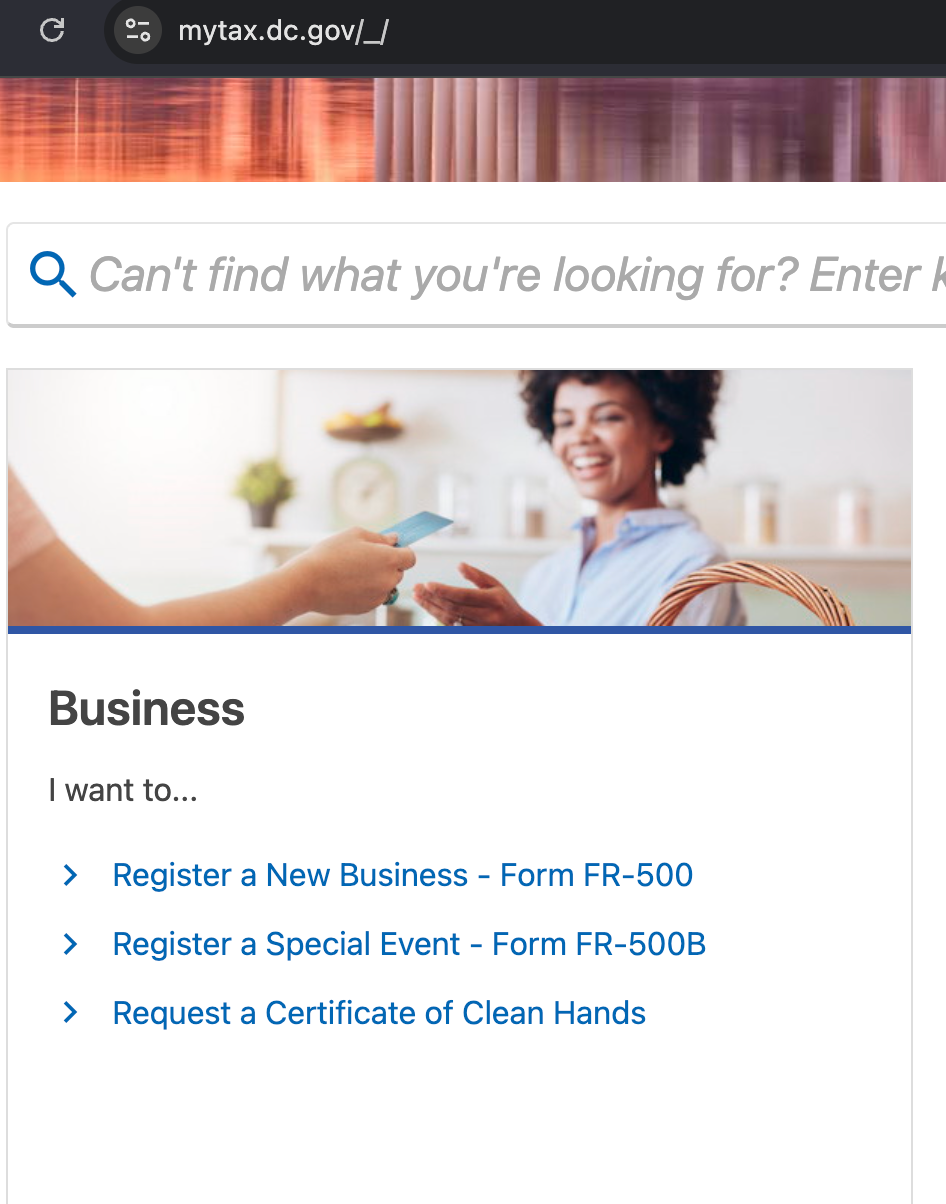
You will need to provide your:
You may also need your articles of Incorporation (for C-corporations), Articles of Organization (for LLCs), or your Certificate of Trade Name (if applicable).
After you have registered, OTR will assign you a filing frequency based on the amount of sales tax you're expected to owe. While this could be monthly, quarterly, or annually, many online sellers must submit monthly reports.
It's important to register immediately once you establish nexus—ideally before your next taxable sale if you are a remote seller who crosses the economic nexus threshold.
Delaying registration can create exposure, as you may owe back taxes, interest, and penalties dating back to the day nexus was established if you are not collecting and remitting tax properly.
Once you've registered, you must begin charging customers tax at the correct rate on all taxable sales.
For most ecommerce sellers, including those selling physical goods and digital products, the general rate applies. This rate is 6% currently, but will rise to 7% on October 1, 2026.
Other rate categories may also apply depending on your business. The table below shows the rates for different types of goods and services.
| Category | Tax rate |
|---|---|
| General sale or medical marijuana | 6% (7% as of 10/1/26) |
| Sale of or charges collected to play commercial bingo | 7.5% |
| Soft drink | 8% |
| Food, drink prepared for immediate consumption or spirituous or malt liquors, beer, and wine sold for consumption on the premises where sold | 10% |
| Rental vehicles | 10.25% |
| Spirituous or malt liquors, beers, and wine sold for consumption off the premises where sold, unless sold by an alcoholic beverage licensee | 10.25% |
| Rooms, lodgings, or accommodations | 15.95% |
| Parking or storing of motor vehicles or trailers | 18% |
Pro Tip: If you sell through certain online platforms, including Amazon, eBay, or Etsy (but not Shopify), the platforms are considered marketplace facilitators. Washington, D.C., law requires marketplace facilitators to collect and remit tax for you. However, since not every platform that allows third-party sales is a marketplace facilitator, you should always check with the platform to understand your obligations. And remember, marketplace facilitators do not register for you or manage tax for off-platform sales.
You are required to file regular reports with the Office of Tax and Revenue (OTR). Your required filing schedule could be monthly, quarterly, or annually, depending on your volume of taxable sales.
Whatever your reporting cadence, your returns are due on the 20th of the month after the reporting period. So if you file monthly, April's report is due May 20. If the 20th falls on a holiday, you must file by the next business day.
Here are the steps to take to log in and file your required forms.
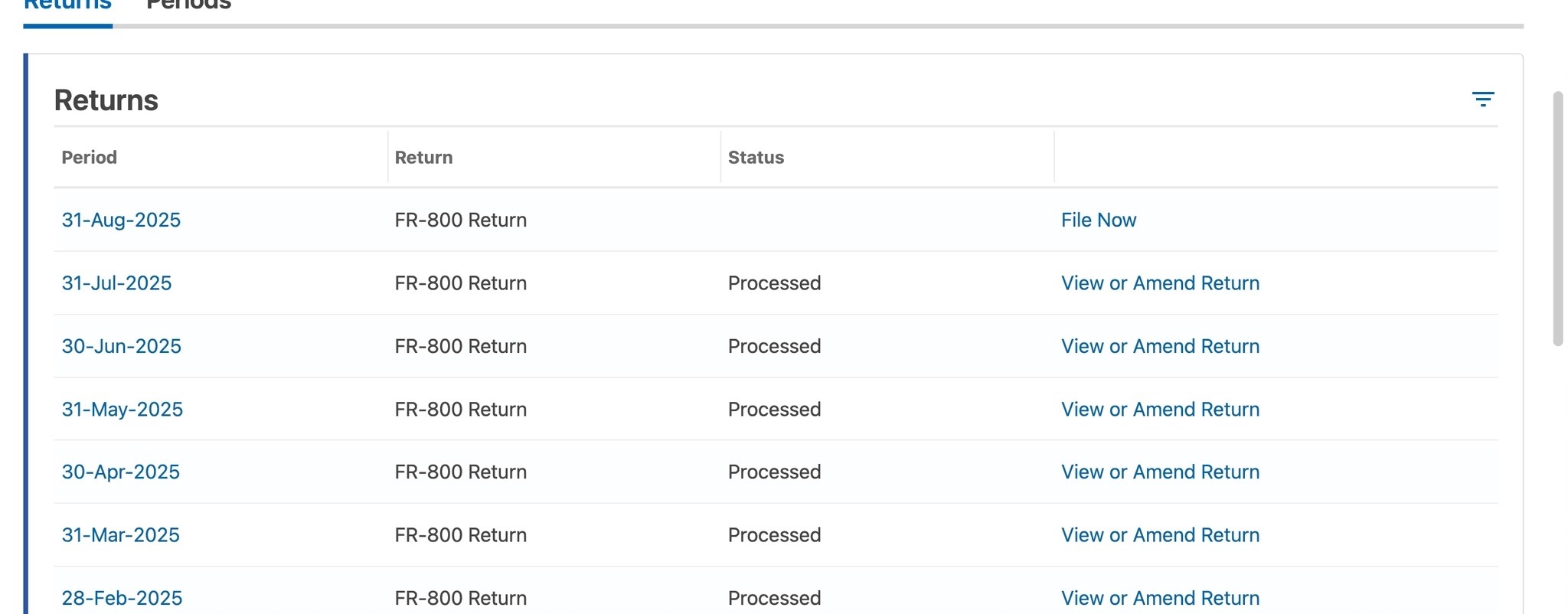
Navigate to mytax.dc.gov, log in with your business credentials, and locate the Sales and Use Tax Account. Then, click "View Returns," and select the option to "File Now."
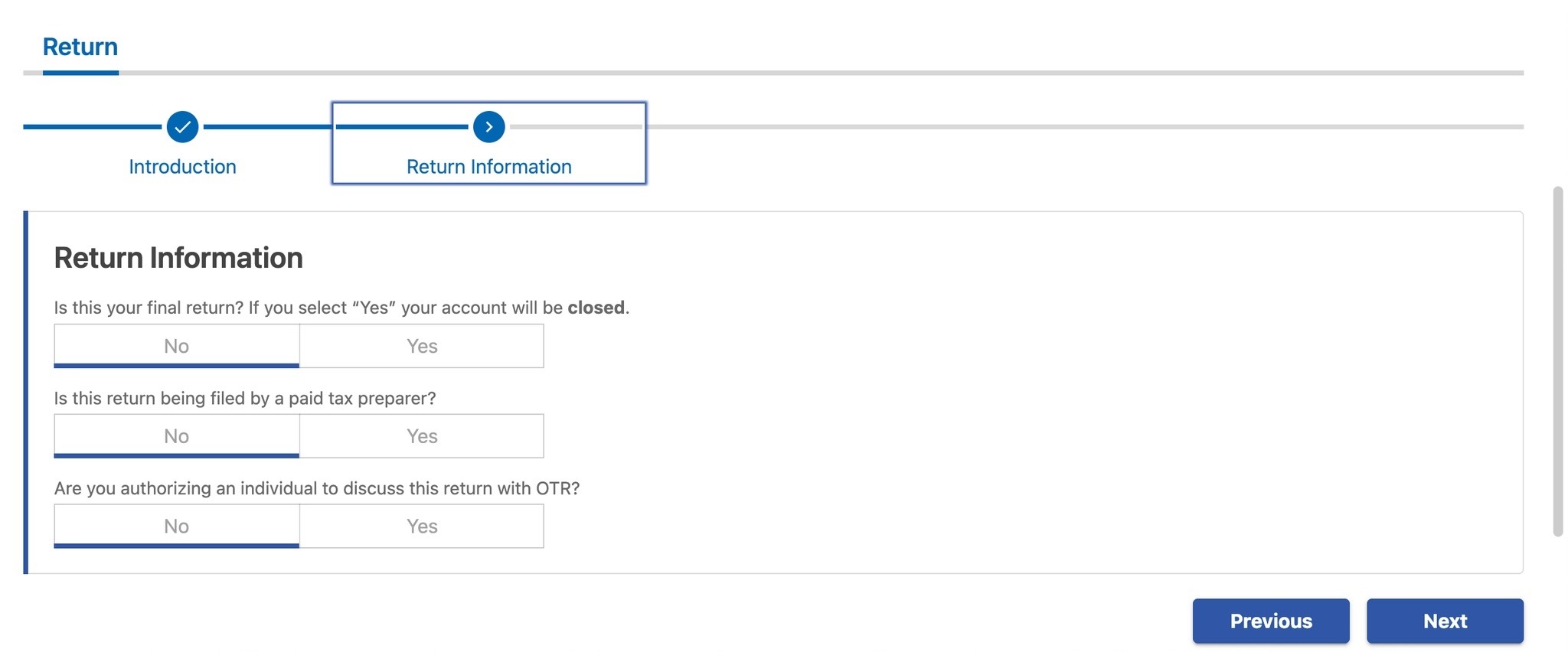
After clicking File Now, the first screen is in the Return Information section.
On this screen, you'll read introductory language and answer questions specific to the return you are filing, such as whether it is an amended return or not.
Once you have answered the questions, click "Next."
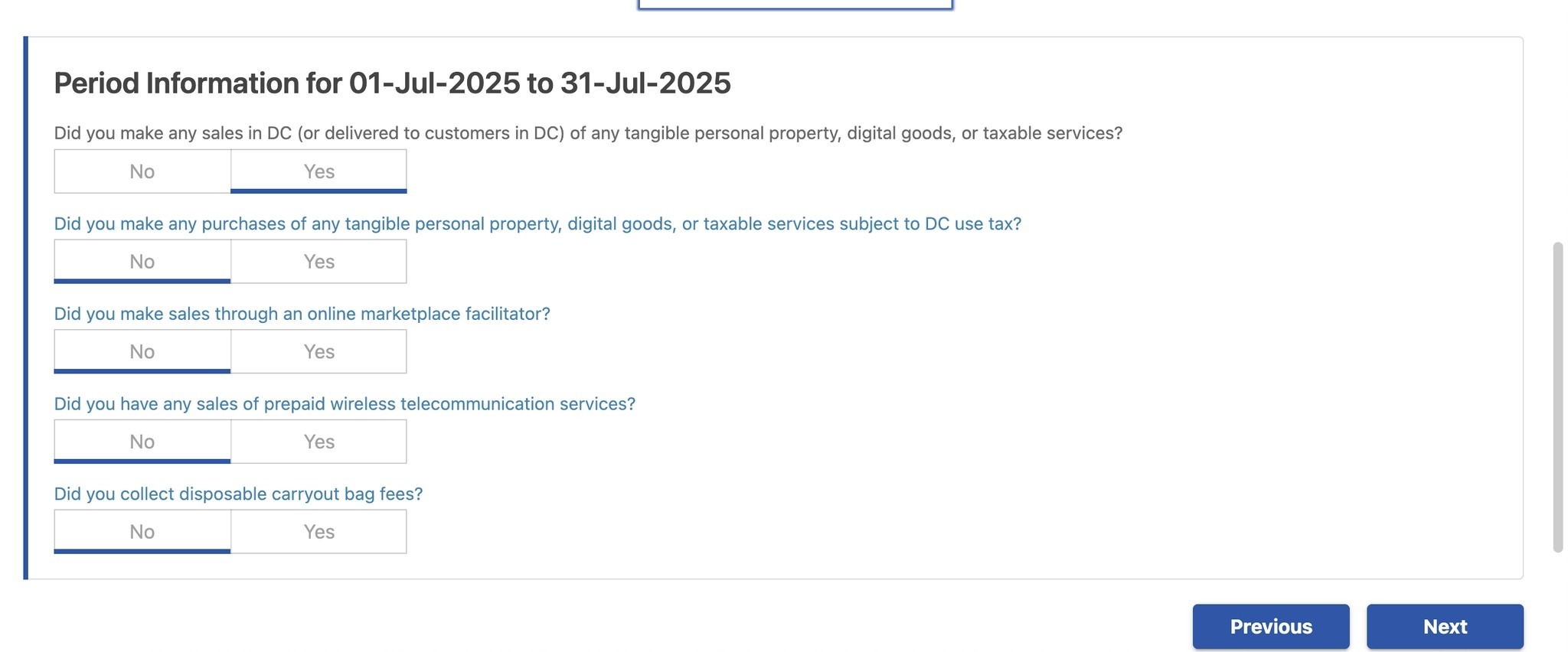
You will also have to select the filing period you are submitting the return for. This is done on the Period Information screen.
Look at the information on the screen to confirm the dates are correct, then click "Next."
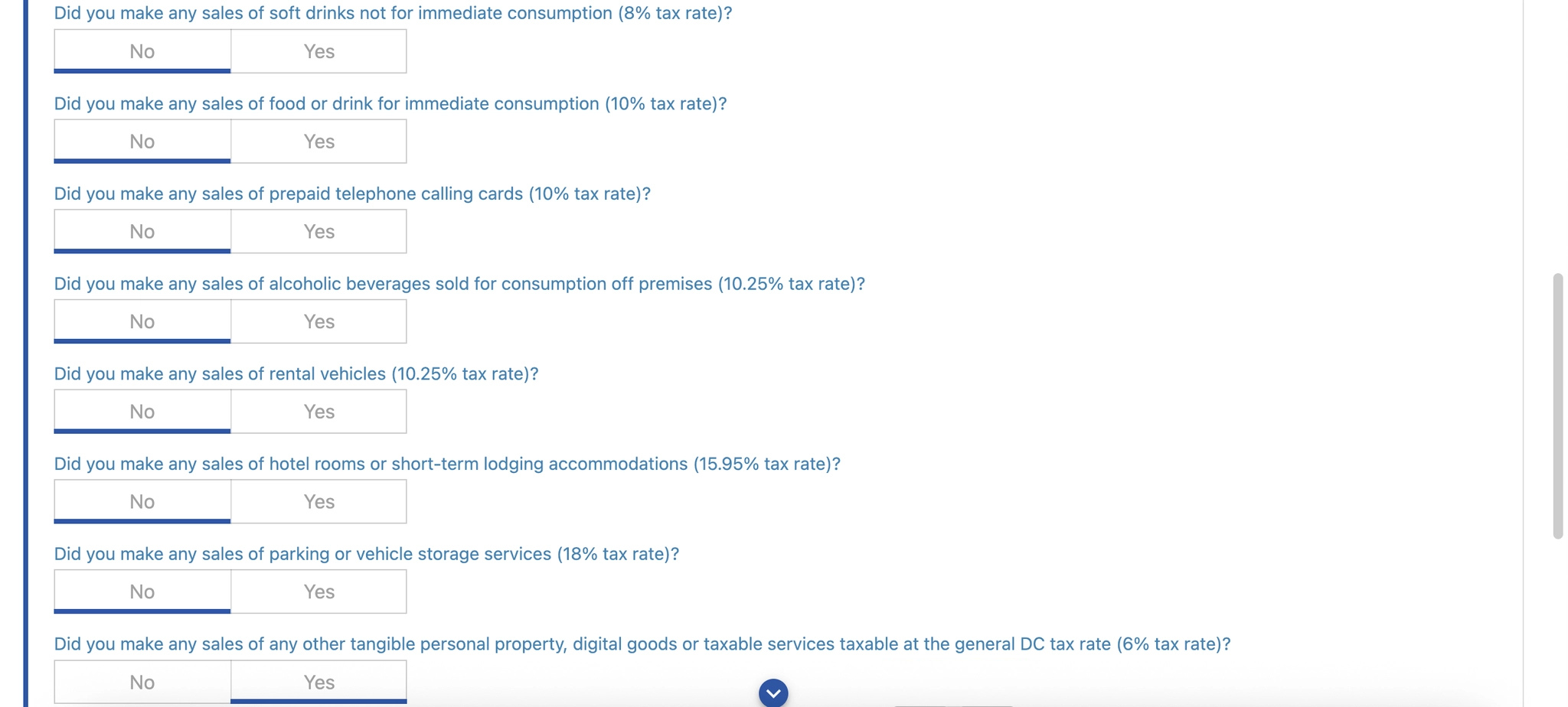
Once you have the return type and period chosen, you'll be taken to the main data-entry screen. This is where you will complete your Sales & Use Tax Return, using Form FR-800M for monthly filers.
You will need to provide detailed information on this page about key numbers, including your:
Once you have submitted all of the required information, you can click Next.
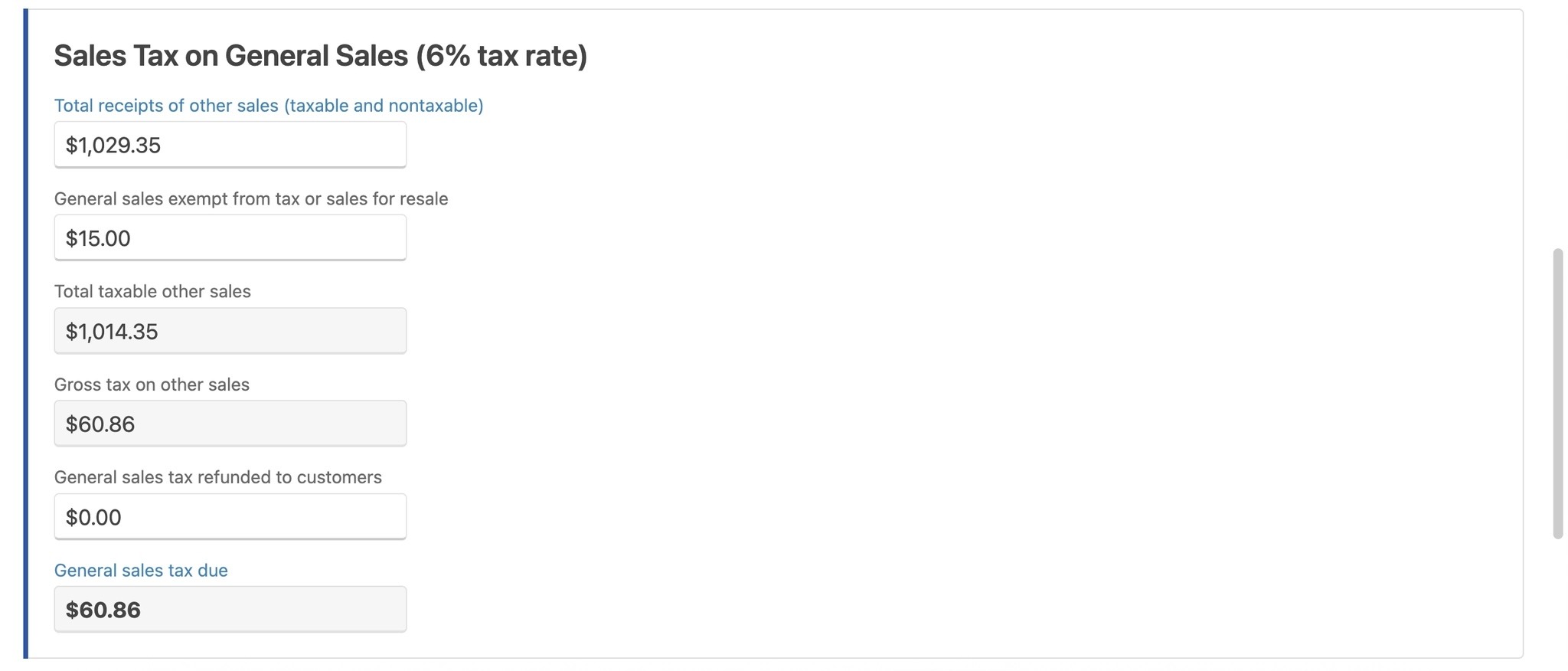
You will be provided with an opportunity to review a summary of your return before submitting. Check the summary carefully for any mistakes, and confirm that the tax due as shown on the website matches your records.
When you're ready to submit, you must re-enter your MyTax.DC.gov password. This step is required to confirm your identity. Once it's complete, click Submit.
After you have submitted, you will see a confirmation screen. Be sure to download the confirmation, including the filing receipt, and document the confirmation number and filing receipt to keep on record as proof of submission.
If you are not able to complete the entire submission process in one sitting, you can also choose the "Save Draft" option to ensure you don't lose your progress.
In addition to filing sales tax forms, you also must remit payment if you owe sales tax. Payment can be made electronically via MyTax.DC.gov at the time of filing.
Keep a record of the payment and the return submission for the entire lookback period, which is the greater of three years or the date nexus was established in D.C. It may extend to six years if taxable sales are underreported by 25% or more, and there's no time limit if no return was filed.
[inline-cta title="Let us worry about sales tax." text="The trusted solution for U.S. sales tax, VAT, and GST compliance, used by 3,500+ global businesses. " button="Get started for free" button-link="/get-started"]
Every jurisdiction has some differences in its sales tax rules and regulations. D.C. is no exception.
The good news is, while Washington, D.C., is a federal district and not a U.S. state, its compliance framework is broadly similar to other states, unlike a territory like Puerto Rico, which has a separate framework entirely.
However, the key difference D.C. sellers must be aware of is the multiple special sales tax rates, as D.C. has more distinct rate tiers based on the items being sold than other jurisdictions do. This creates complexity because sellers must apply the right rate to the right transaction type.
Sellers must also be aware of the upcoming change to the general rate from 6% to 7% beginning October 1, 2026, and must update their tax settings by that date.
Finally, those filing in D.C. must understand that the tax authority in the District is the Office of Tax and Revenue (OTR). Filing occurs through MyTax.DC.gov, which is a separate system from any state tax portal.
Not everyone is required to collect, file, or remit sales tax in Washington, D.C. This obligation exists only if you have nexus. There are two ways to establish nexus you should know about.
Physical nexus refers to physical connections in Washington, D.C. As soon as a business has a physical presence of any type, it establishes physical nexus. This could include:
Any type of physical presence can create nexus, and require you to collect and remit sales tax on purchases in the District.
Physical nexus was traditionally the only way to establish nexus, but a Supreme Court case called South Dakota v. Wayfair, Inc., allowed local governments to begin requiring companies to collect sales tax if they had enough economic connections to the area (in this case, the District).
Many jurisdictions throughout the U.S. imposed similar definitions of economic nexus, including Washington D.C, where you can establish nexus if you have:
Either threshold will automatically trigger a registration requirement. And, in Washington, D.C., all sales, including exempt transactions and those where marketplace sellers collect tax, will count toward determining if you have triggered nexus.
If you are approaching the nexus threshold, it's important to be proactive in tracking sales and make sure to register right away after the threshold has been crossed, if not before.
If you are a marketplace seller and you sell through a marketplace facilitator like Amazon, eBay, or Etsy, then the marketplace facilitator will be responsible for collecting and remitting tax to D.C. on your behalf.
However, you remain responsible for compliance with sales tax rules. Sales on the marketplace count toward establishing nexus, and if you establish economic or physical nexus, you still must register in the state and collect sales tax on sales that take place off the marketplace.
You should verify with any platform you sell on that they are a marketplace facilitator and that D.C. is covered in their tax collection.
Most tangible items are taxable at the general rate in D.C., and digital goods, including SaaS, are taxable as well. D.C. does have tiered rates, though, so some products are taxed at a higher rate than the standard general rate.
Items that are commonly taxable in D.C. include:
While most goods and some services are taxable, there are also exempt items that you do not charge tax on. The table below shows how some commonly exempt items are treated in D.C.:
| Category | Tax rate |
|---|---|
| General sale or medical marijuana | 6% (7% as of 10/1/26) |
| Sale of or charges collected to play commercial bingo | 7.5% |
| Soft drink | 8% |
| Food, drink prepared for immediate consumption or spirituous or malt liquors, beer, and wine sold for consumption on the premises where sold | 10% |
| Rental vehicles | 10.25% |
| Spirituous or malt liquors, beers, and wine sold for consumption off the premises where sold, unless sold by an alcoholic beverage licensee | 10.25% |
| Rooms, lodgings, or accommodations | 15.95% |
| Parking or storing of motor vehicles or trailers | 18% |
Complying with D.C. sales tax requirements is critical because there are serious consequences if you don't follow the rules. Here are some of the potential penalties you could face:
If you realize you should have been filing but are out of compliance, D.C. has a voluntary disclosure program through OTR that can reduce or eliminate penalties. You should always consult a tax professional before approaching OTR directly.
You can learn more about voluntary disclosure agreements here.
If all of these obligations seem overwhelming, there is a solution. With Numeral, you don't have to manage your MyTax.DC.gov account, collect tax, prepare returns, or remit payments. You don't even have to answer your own sales tax mail from D.C. Numeral can do it all.
Numeral allows you to manage sales tax compliance across every state and D.C., as well as international VAT and GST tax compliance, in as little as five minutes per month. We offer:
[inline-cta title="Let us worry about sales tax." text="The trusted solution for U.S. sales tax, VAT, and GST compliance, used by 3,500+ global businesses. " button="Get started for free" button-link="/get-started"]
If you still need to know more, here are the answers to some frequently asked questions about Washington, D.C., sales tax.
Does Washington, D.C., have sales tax?
Washington, D.C., does charge a sales tax. If you have physical or economic nexus, you are required to collect and remit tax on sales made within the District as well as online sales to District residents. The general rate is 6%, but it's increasing to 7% on October 1, 2026.
What is the sales tax rate in Washington, D.C.?
The general sales tax rate in D.C. is 6%, but it's increasing to 7% on October 1, 2026. D.C. also has a tiered system, so higher rates are charged on certain items, such as hotels or alcohol. Some items, such as groceries and certain medical devices, are exempt from sales tax.
Do I need to collect D.C. sales tax if I sell online?
You need to collect D.C. sales tax if you sell online once you establish physical or economic nexus. Physical nexus involves any type of physical presence, including employees in D.C. Economic nexus is established once you have $100,000 in gross sales or 200+ transactions.
How do I register to collect sales tax in Washington, D.C.?
To register for sales tax in D.C., first get a Basic Business License if required. Then submit FR-500 New Business Registration online at MyTax.DC.gov. Once you have registered, you will need to collect sales tax, file sales tax forms, and remit tax payments on the required schedule.
What's exempt from D.C. sales tax?
Certain items are exempt from D.C. sales tax, including unprepared foods, prescription drugs, qualifying medical devices, and sales to qualifying non-profits, the U.S. government, or resellers.
When is Washington, D.C., sales tax due?
Some businesses have monthly filing requirements in D.C., while others file quarterly, biannually, or annually. Your sales tax return and payment are due the 20th of the month after the end of your filing period, so if you file monthly, you must submit April's payment by May 20.
The trusted solution for U.S. sales tax, VAT, and GST compliance, used by 3,500+ global businesses.