Your startup probably doesn't need enterprise tax software, but it may need more than a spreadsheet sooner than you think. Here's how six startup-friendly sales tax tools compare on cost, contracts, and how much work they take off your plate.
Startups grow fast, which creates sales tax challenges. A startup without a finance team may not realize how a strong sales quarter or a remote hire in a new location can create new tax obligations, leaving the company vulnerable to compliance risks.
Sales tax software can solve these problems, but the right software solution depends on your growth stage, company type, and how hands-on you hope to be.
If you want registration and filing handled for you with no required annual contract, Numeral offers free nexus monitoring and charges $75 per filing once you have returns to file.
Kintsugi offers a free plan for founders who prefer a self-service solution, while Anrok fits global startups, and Stripe Tax works for early-stage startups already billing in Stripe.
This guide provides insight into the best sales tax software for startups so you can pick the one that's right for you.
Best sales tax software for startups at a glance
The table details the key features of different sales tax software that can make sense for startups.
Platform
Best for
Free monitoring or trial
Pricing model
Contract
Numeral
Startups that want filing and registration handled without a platform fee
Yes, nexus monitoring and nexus study
$75/filing, $150/registration
None
Kintsugi
Self-serve founders who want a free starting point
Yes, nexus monitoring
$75/filing or registration
None
Anrok
SaaS startups selling globally
No
$100 per market/month (Starter)
None
Stripe Tax
Early-stage startups already billing in Stripe
No; Basic is usage-based
0.5% per transaction (Basic); from $90/mo (Complete)
One-year contract required for Tax Complete No contract for Tax Basic
TaxJar
Bootstrapped ecommerce startups selling on marketplaces
30-day free trial
From $39/mo + $50 to $55 per AutoFile return
Monthly plans available Discount for annual plan
Quaderno
Solo founders selling digital products internationally
7-day trial
From $29 per month Custom quote is required for filing service
Not required
Best sales tax automation software for startups
Here are additional details on how different sales tax software solutions can meet startups' needs.
1. Numeral: Best for startups that want sales tax handled from day one
Best for: Startups that want free nexus monitoring and a full end-to-end solution as they grow, with filing and registration done for them as needed, with no long-term commitments
Why startups pick Numeral
Numeral is the best tax automation software for startups that want a partner that scales effortlessly, takes on tax obligations as they grow, and requires no long-term commitments.
Startups choose Numeral because:
Nexus monitoring is always free and includes a nexus study to help founders identify historical exposure and locations where they will soon establish nexus. No spend is required to understand the scope of your sales tax obligations.
Numeral's role grows effortlessly as you grow, with no long-term commitments or onboarding fees. Once you establish nexus, Numeral auto-registers for you, then files and remits every return. A human team reviews filings, so no one on your team has to become a sales tax expert or spend more than five minutes a month on sales tax.
Numeral is built to scale with you.Numeral integrates with the software startups use, including Stripe, Chargebee, Shopify, QuickBooks, and NetSuite. The Rippling integration also helps track physical nexus from remote employees.
Numeral offers international support when you expand abroad, with VAT and GST covered in 90+ countries on the Enterprise plan.
The Numeral Guarantee is best in class. It covers penalties and interest if we file late.
Numeral is trusted by startups and venture-backed clients. Brex, Character.ai, and Supabase are among the many startups that trust Numeral.
Monitoring only: $0. Startups can choose the free monitoring-only plan even if they already have nexus in some states.
Registration: $150 per registration. You pay only when we register you, which becomes necessary when you establish nexus in a new state.
Filing: $75 per filing. You pay only when we file for you, with no per-transaction or setup fees.
Startup perk: Numeral offers 50% off for the first three months for new customers through Mercury's perks program.
Tradeoffs as you grow
Numeral's per-filing pricing scales with the number of states and filing frequency.
You'll need the Enterprise plan for VAT and GST coverage and API access, so startups expanding internationally or filing at high volume will move to Enterprise.
2. Kintsugi: Best for self-serve founders who want a free starting point
Best for: Founders comfortable with hands-on setup who want to start with a free plan
Why startups pick Kintsugi
Startups choose Kintsugi because:
Nexus monitoring is free.
Setup is quick, with no long-term contracts required.
Starter offers strong customer support, including 24/7 live chat.
Pricing at startup scale
The Free plan includes nexus monitoring, threshold alerts, and product categorization.
Starter costs $75 per registration or filing.
Scale and Premium plans have custom pricing.
Tradeoffs as you grow
The Kintsugi Guarantee is available only for the Scale and Premium plans.
Starter covers the U.S. and Canada; VAT and GST in the EU, UK, and 100+ other countries require the Scale or Premium plan.
Voluntary disclosure management is available only on the Premium plan, which can be an issue for companies trying to clean up past exposure.
Best for: SaaS startups with an international customer base early on
Why startups pick Anrok
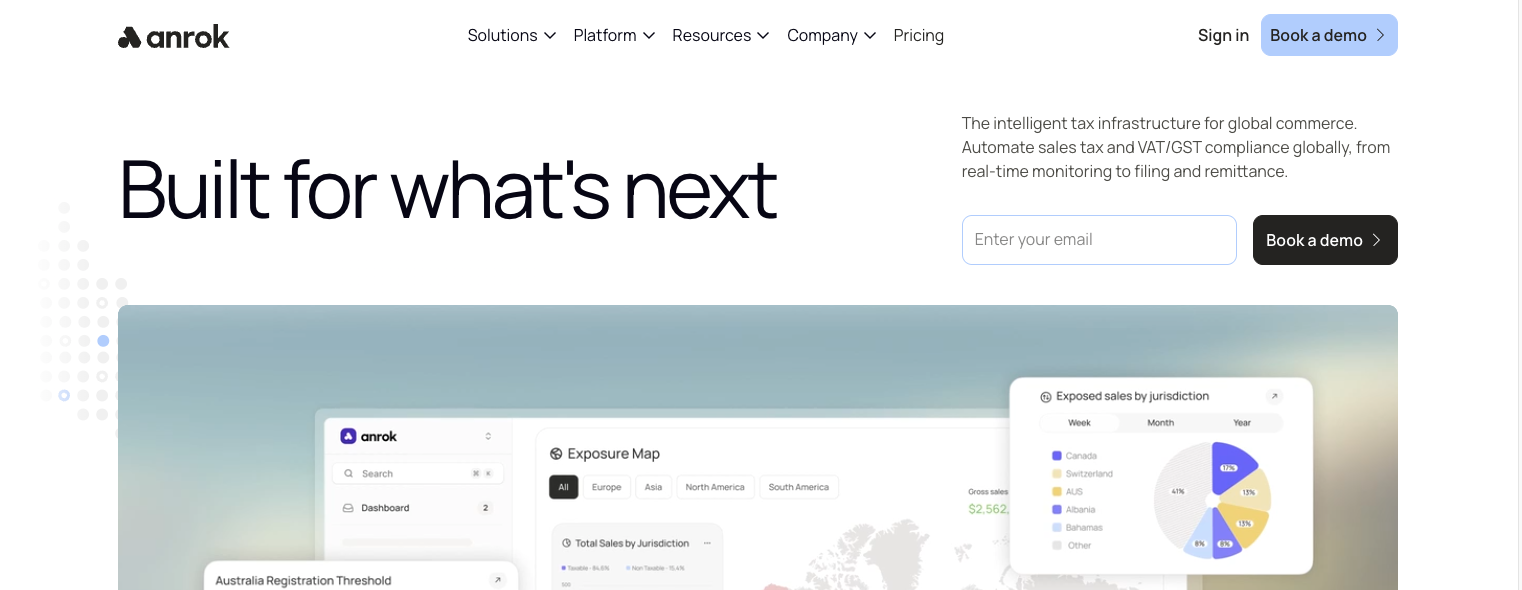
Anrok was built for SaaS companies with a strong focus on software taxability and billing-system integrations, including with startup-friendly tools like Stripe and Chargebee.
Anrok excels at tracking physical nexus for distributed teams using HRIS-based tools.
VAT and GST support is available.
Pricing at startup scale
Starter is $100 per market per month. Filings are included.
Custom plans have custom pricing.
Tradeoffs as you grow
Anrok's per-market fees are charged monthly for all registered markets, regardless of whether you must file that month.
Costs climb as you register in more jurisdictions, even in low-revenue markets.
4. Stripe Tax: Best for early-stage startups already billing in Stripe
Best for: Early-stage startups that are already using Stripe for billing
Why startups pick Stripe Tax
It's easy to use. You can turn it on in Stripe without setting up a separate vendor.
Tax Basic provides nexus monitoring (based on on-platform sales) and calculation with usage-based pricing and no monthly fees.
Tax Complete adds registration and filing.
Pricing at startup scale
Tax Basic charges 0.5% per transaction (no-code) or 50 cents per transaction (API).
Tax Complete starts at $90 per month with a one-year contract. The entry-level tier includes two registrations and four filings per year.
Tiered plans go up to $1,500 per month for 5,000 transactions and 50,000 calculation API calls a month. Higher volumes are quoted, and extra fees may apply if you exceed your plan's limits.
Tradeoffs as you grow
The filing and registration allowance is limited and may not be enough as you grow.
Moving up to higher tiers for more transactions, registrations, and filings can significantly increase your price.
5. TaxJar: Best for bootstrapped ecommerce startups selling on marketplaces
Best for: Bootstrapped ecommerce founders who sell on ecommerce sites like Amazon, Etsy, or Shopify and who want self-serve tools
Why startups pick TaxJar
Setup is easy with strong marketplace integrations.
AutoFile is available with a late filing guarantee.
Pricing at startup scale
The Starter plan starts at $39 per month or $419 annually and includes up to 200 orders/month. Starter includes two AutoFile credits a year and then $50 per return.
The Professional plan starts at $99 per month or $1,069 annually. This tier adds access to the API.
Registrations are $299 per state.
Tradeoffs as you grow
The subscription price rises with monthly order volume.
Registration fees can be very high as you expand into new states.
6. Quaderno: Best for solo founders selling digital products internationally
Best for: Indie founders and very small teams that sell digital products or courses to customers in multiple countries
Why startups pick Quaderno
Monthly prices are low, and there's an annual discount.
Quaderno is excellent for international sellers because it provides international tax calculations in one tool, plus compliant invoices in multiple languages.
Pricing at startup scale
Plans start at $29 per month, and costs are based on transaction volume.
Managed registrations and filings cost extra, and custom pricing is required.
Tradeoffs as you grow
Entry-level Hobby plan supports only a single tax jurisdiction and integration, which is too limiting for founders selling internationally. Most companies need a higher-tier plan.
Plans cap monthly transactions.
There is no published pricing for filing services, so you must get a quote to understand your likely costs as you grow.
When does a startup need sales tax software?
Sales tax software is important for any startup that may incur sales tax obligations.
A free nexus monitoring plan like Numeral's can alert you to obligations before you fall out of compliance, and Numeral's tax calculation engine integrates with all your sales platforms to ensure you charge the correct tax on every transaction.
Startups that have tax obligations across multiple states need more support, including an end-to-end compliance solution. Sales tax software can simplify and manage obligations, including registrations and recurring filings.
While a software program is not required by law, compliance is, and it can be burdensome without support.
Four factors that shape a startup's obligations
Four primary factors determine a company's sales tax obligations. Here are the key factors that affect the compliance requirements your company is subject to:
Economic nexus: The Supreme Court opened the door to economic nexus in South Dakota v. Wayfair, and states can now require you to collect sales tax once you have sufficient local economic connections. The specifics vary by state, but $100,000 in annual sales into the state or 200 total transactions is a common threshold.
Physical nexus:Physical nexus was traditionally the only way to become required to collect sales tax, and the definition is broad. A single local employee, items stored locally through programs like Fulfillment by Amazon, or even a trade show appearance could create physical nexus.
What you sell:SaaS and digital products are exempt in some states, but are taxable in a growing number of jurisdictions, including California starting in 2027. Different startups can have very different sales tax obligations depending on the products they sell.
Marketplace connections: If you sell on a platform that is a marketplace facilitator, such as Amazon or eBay, the marketplace may collect and remit sales tax on your behalf. You may still have to track sales to determine if you establish nexus. However, storing inventory through Fulfillment by Amazon or similar programs can trigger physical nexus.
You must determine when you have established nexus and register, then begin filing and remitting. If you fail to register and fulfill your obligations by the deadline in each state (and sometimes within local jurisdictions), you face an audit risk.
What to use at each stage
The table below shows what type of support your startup may need at each stage.
Situation
What you likely need
Example tools from this list
Pre-revenue, with no current registration or filing obligations
Nexus monitoring and a taxability assessment
Numeral or Kintsugi free plans
Making taxable sales in locations where you have physical nexus, including your home state
Registration, sales tax calculation, collection, and filing and remitting
Numeral, Kintsugi, Stripe Tax Complete
Approaching your first out-of-state threshold
Nexus monitoring and sales tax calculation; a process in place to register and collect before you cross
Numeral, Kintsugi, Stripe Tax
Registered in one or more new states
Automated registration and filing
Numeral, Kintsugi, TaxJar
Selling in many states or internationally
Managed multi-state and global compliance
Numeral, Anrok
What startups should look for in sales tax software
Startups have unique needs when choosing sales tax software because it must fit their budgets and support future growth. Here are some key features to consider:
Free until you owe: A free monitoring plan lets you track your obligations without a monthly bill until you actually have them.
No long-term contracts: A month-to-month solution gives you the flexibility you need as your company evolves.
Pricing that matches your footprint: Per-filing pricing benefits startups that file in only a few states or don't have monthly filing obligations because their sales volume isn't high enough. Per-market subscriptions that charge monthly for each registered market can be unnecessarily expensive when you don't file monthly.
Fast setup: Startups move quickly, and you don't want sales tax to impede growth. Look for a tool that offers integration with the billing, ecommerce, accounting, and HR tools you already use, like Stripe, Shopify, QuickBooks, and Rippling.
Registration included or priced clearly: As you expand into new markets, you may quickly establish nexus in multiple jurisdictions and must begin registering. Costs can add up quickly, and you need to know pricing without having to make a phone call every time.
Support with notices: Sales tax notices and mail from state revenue authorities often land on a founder's desk if your software solution doesn't support them. Numeral offers a virtual mailbox and responds to this correspondence on your behalf.
Room to grow: Expansion brings new responsibilities. You need a solution that can manage exemption certificates for B2B deals and support VAT and GST as you expand outside of the United States.
Help with back exposure: Many startups don't look into sales tax compliance until it's already a problem. You need a company that can help clean up back exposure and limit liability.
How sales tax affects fundraising and acquisitions
Startups need to manage sales tax exposure before it compromises fundraising or puts a potential acquisition at risk.
Investors and acquirers review sales tax exposure during due diligence. If your company failed to collect tax, you may owe the full amount of unpaid liabilities even if you can't recover it from customers.
If you have unaddressed exposure, this can result in:
Escrow or a requirement to put money into an account to cover unpaid sales tax liabilities
Delays in closing as sales tax compliance issues are resolved
If you're registered in the required jurisdictions, current on your filings, and fully compliant with your obligations, sales tax won't be an obstacle. Raising funds is simpler, and you won't incur substantial costs when problems are found during due diligence.
What to do if your startup is already behind on sales tax
If your startup is already behind on sales tax, take a strategic approach to becoming compliant.
Don't rush to register in every state where you have nexus, as this could open you up to audits or back-tax charges if you have unpaid liabilities. Registering will not resolve historical liability if you delayed registering, filing, or remitting.
Instead, explore options like voluntary disclosure agreements. You can arrange these anonymously, and they offer benefits such as a limited lookback period and a penalty waiver for voluntarily reporting unpaid liabilities.
Contact with a state can affect your eligibility for these programs, so do not register without understanding your options. For example, California's voluntary disclosure program is only open to out-of-state businesses that have never registered with or been contacted by the CDTFA.
Numeral can help you identify unpaid liabilities and explore solutions to limit your exposure. Our nexus study helps identify historical exposure. We offer options to help resolve unpaid liabilities, and we'll register and handle filings on your behalf once you decide on a path forward.
Some states also offer limited-time amnesty programs that let you come forward and voluntarily report unpaid tax liabilities. You can review our sales tax amnesty programs guide to explore options.
While solutions exist, it's best to stay compliant from the start. Numeral makes that effortless, so contact us to learn how we can help.
Let us worry about sales tax.
The trusted solution for U.S. sales tax, VAT, and GST compliance, used by 3,500+ global businesses.
Christy is a personal finance and legal writer with a JD from University of California, Los Angeles. She has written for WSJ Buy Side, Fox Business, CBS MoneyWatch, Miami Herald, CNN Underscored, and more.