Businesses that collect Minnesota sales tax register for a Minnesota Tax ID Number and a Sales and Use Tax account with the Minnesota Department of Revenue. Registration is free. You can apply online through e-Services, and your confirmation letter replaces a sales tax permit. Remote sellers need to register once they make more than $100,000 in retail sales or 200 or more retail sales into Minnesota in the prior 12 months.
You need to register for a Minnesota Tax ID Number and a Sales and Use Tax account if you have taxable presence in Minnesota and make taxable sales in or into the state. You have to register before your first taxable sale.
If you sell only nontaxable items, you don't need a sales tax account, though you may need to register to pay use tax on your taxable purchases.
Minnesota doesn’t tax SaaS, so if SaaS is all you sell, you don’t need a sales tax account. Prewritten software that customers download or receive on physical media is taxable, though, so if you sell both, you need to register.
If you have no physical presence in Minnesota, you need to register once you cross the Minnesota economic nexus threshold. You cross it when your retail sales shipped to Minnesota in the prior 12-month period include either:
Minnesota calls this the Small Seller Exception. You check it each month against the most recent 12 months, not by calendar year. For example, check August through July, then September through August.
Minnesota counts:
Sales for resale don't count, as long as the buyer gives you a completed Form ST3, Certificate of Exemption.
You must register and start collecting by the first day of a calendar month that falls no later than 60 days after you exceed the threshold.
For example, if you exceed the threshold on May 15, you need to be registered and collecting by July 1.
If you crossed the threshold in the past and never registered, a voluntary disclosure agreement may limit the look-back period and penalties. To qualify for Minnesota's Voluntary Disclosure Program, you generally can't have been contacted by the department about your tax compliance or have filed returns for that tax already.
Businesses located in Minnesota need to register before their first taxable sale. Out-of-state sellers with physical nexus must also register, regardless of sales volume.
Any of these gives you taxable presence in Minnesota:

If you sell in person in Minnesota, whether from a store or at a trade show, you need to register and collect tax on those sales from the first day. Business activity in the state can also require you to collect tax on orders you ship to Minnesota.
That happens once you’re active in Minnesota on at least four days in 12 months. Trade show days, soliciting orders, and repair or warranty work count toward the four days. Setting up and taking down a display doesn’t.
From the fourth day, you collect tax on all sales into Minnesota for the next 11 calendar months.
An affiliate's activity in Minnesota can also give you presence, for example, when a related company promotes your products or accepts your returns there.
You're also presumed to have a solicitor in Minnesota if residents refer customers to you for a commission, such as through website links. The presumption applies only when those referred sales total at least $10,000 in the 12 months ending on the last day of the most recent calendar quarter, and you can rebut it.
Under Minnesota's marketplace facilitator law, marketplaces with a place of business in Minnesota, and out-of-state marketplaces that meet the same thresholds, collect tax on the sales they facilitate.
The exception is when you give the marketplace a copy of your Minnesota registration, and you both agree you'll collect.
Whether you still need your own account depends on whether you have a physical presence in Minnesota and how you sell:
Inventory in a Minnesota fulfillment center, as with many Amazon FBA sellers, gives you sales tax nexus in Minnesota no matter how much you sell.
You need to register even if the marketplace collects the tax on your sales. On your returns, exclude the sales the marketplace already taxed.
You can't open a new Sales and Use Tax account while you owe past-due Minnesota sales tax. Pay it first, or contact the department's Collection Division.
The department won't issue a Minnesota Tax ID Number more than one year before you start operating. A business needs only one Minnesota Tax ID Number for all its Minnesota taxes.
For each owner, officer, or trustee, you'll need:
Partnerships, LLPs, and multi-member LLCs must list at least two owners or officers. If a business owns yours, you'll need its name, FEIN, address, and any Minnesota Tax ID Number.
The sales and use tax section of Form ABR also asks:
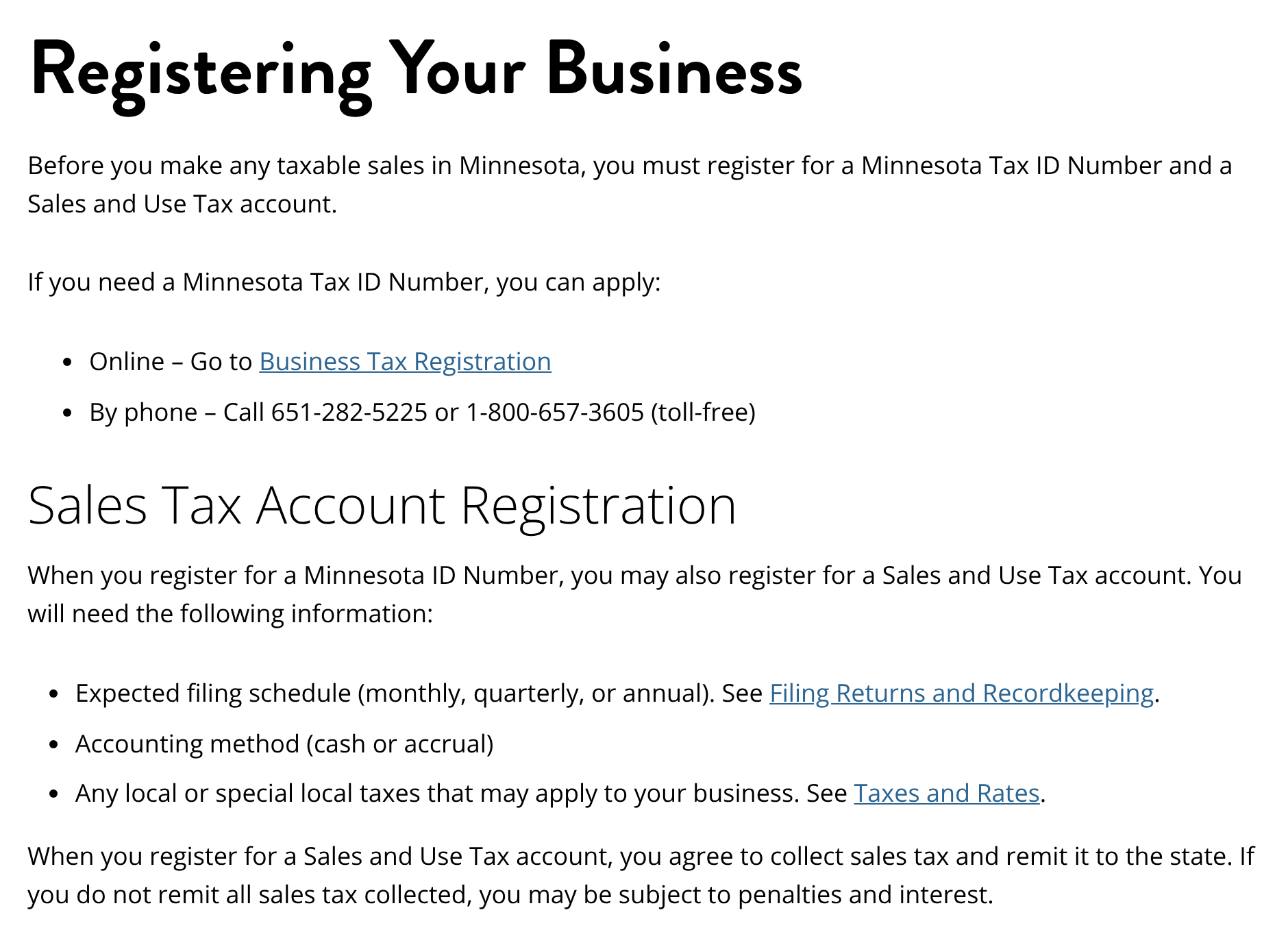
You can register online through e-Services, the Department of Revenue's filing system, or by phone at 651-282-5225 or 1-800-657-3605.
To register on paper, fill out pages 1 and 2 of Form ABR, Application for Business Registration, plus the sales and use tax pages. Fax it to 651-556-5155, or mail it to the Minnesota Department of Revenue, Mail Station 4410, 600 N. Robert St., St. Paul, MN 55146-4410.

If you're registering in several Streamlined Sales Tax member states, you can use the Streamlined Sales Tax Registration System instead. It registers you with all the member states you choose in one application, and you can pick a state-certified service provider to file your returns.
On the Registering Your Business page, select Business Tax Registration.
You can also start from the e-Services login page. Select Create a username below the login fields, then Get a Minnesota ID Number, the option for businesses registering for the first time.
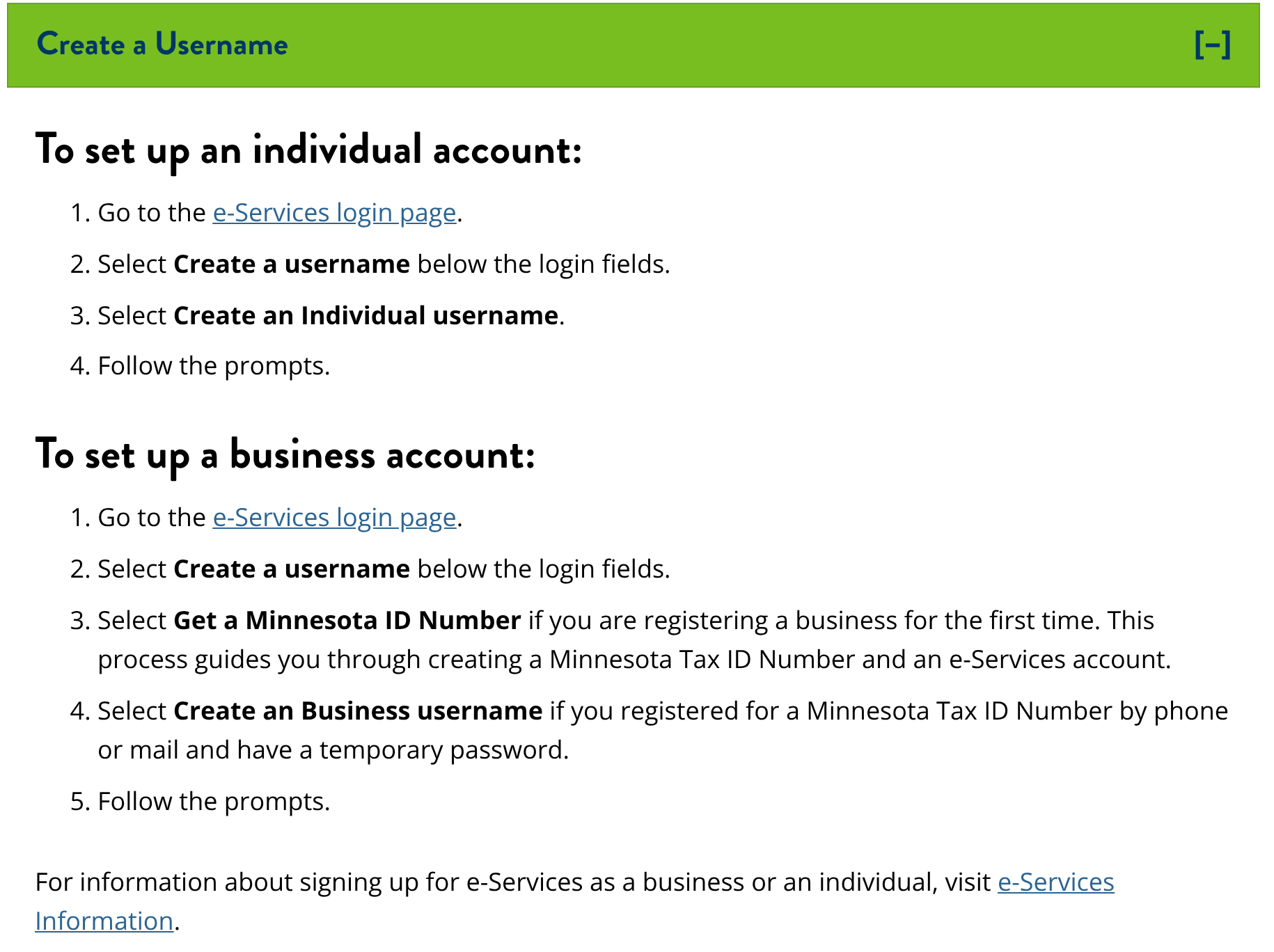
This process creates your Minnesota Tax ID Number and your e-Services account at the same time.
Tip: If you registered by phone or mail, don't use Get a Minnesota ID Number. Select Create a Business username instead and use the temporary password from your confirmation letter.
Follow the prompts and enter the business and owner details listed above. Choose Sales and Use Tax as a tax type, along with any other Minnesota taxes you need, such as withholding.
For the sales and use tax account, you'll need your expected filing schedule, accounting method, and applicable local taxes. The paper Form ABR also asks when you'll make your first taxable sale and whether you're a remote seller.

Then choose the local taxes that apply to you, covered in the local taxes section below. On Form ABR, one box registers you for all local and transit taxes.
After you register, the department sends a confirmation letter with your seven-digit Minnesota Tax ID Number and the tax types it activated. Phone and mail registrants also get a temporary password for e-Services.
Keep the letter with your tax records. Minnesota uses it in place of a sales tax permit.
Registering is free. Minnesota's permit law doesn't set a fee, and Form ABR has no payment section.
There's no renewal fee either, because the registration doesn't expire.
The department may require a security deposit from a retailer to make sure it pays its sales tax. The most it can require is twice your estimated average tax for a filing period or $10,000, whichever is less.
It may require a surety bond instead of a deposit. It may also require a deposit before it reinstates a revoked account.
The Department of Revenue hasn't published a processing time for new registrations.
When you register online, you create your e-Services username during the application. Phone and mail registrants wait for the confirmation letter and its temporary password before they can log in.
Leave time to get your number before your first sale. Making taxable retail sales in Minnesota before a Minnesota Tax ID Number is issued can bring criminal penalties.
All sellers, wherever they're located, collect Minnesota local sales taxes based on where the customer receives the item. The Department of Revenue administers many of these taxes, and you report them on your state Sales and Use Tax return.
You need to register for each local tax that applies where you're located or where you ship. You can choose them when you register or add them in e-Services later.
To add them later, select Manage Locations in the Sales and Use Tax panel, then the View or change location link for the location, then Change location details. The new taxes are added overnight, and you can also add a local tax line while filing a return.
Some special local taxes are administered by a city or county instead of the department. For those, contact the city or county directly.
Minnesota charges a 50-cent Retail Delivery Fee on deliveries in Minnesota that include at least $100 of taxable goods or clothing. Retailers with less than $1,000,000 in Minnesota retail sales in the previous calendar year aren't liable.
If you owe the fee, add the Retail Delivery Fee tax line to your Sales and Use Tax account in e-Services, the same way you add local taxes.
Charge Minnesota sales tax on your taxable sales: the 6.875% state general rate plus any local taxes where the customer receives the item.
Your filing frequency depends on your average monthly tax, including local taxes the department administers:
You give your expected schedule when you register. To change it later, contact Business Registration.
You file Minnesota sales tax returns online through e-Services. Monthly returns are due the 20th of the following month, and quarterly returns are due April 20, July 20, Oct. 20, and Jan. 20.
Annual returns are due Feb. 5 of the following year. If a due date falls on a weekend or legal holiday, you can file and pay the next business day.
If you made no taxable sales in a period, you still have to file a zero return.
Your registration doesn't expire. It's valid until the department cancels or revokes it for noncompliance with sales tax laws. Making retail sales after that can be a felony, with a $100-a-day civil fine.
Remote sellers must keep collecting for at least 12 calendar months after the month they start. To stop after that, you have to tell the department you've stopped soliciting Minnesota sales and confirm you didn't meet either threshold in those 12 months.
Registration rules differ by state, and several require regular renewal.
No. An EIN is a federal tax ID from the IRS. A Minnesota Tax ID Number is a seven-digit number from the Minnesota Department of Revenue that you use to report and pay Minnesota business taxes.
It depends. If you've applied for an FEIN but haven't received it, write "applied for" on Form ABR and contact the department once it arrives.
If you aren't required to have an FEIN, enter "NA" instead. LLCs need an FEIN, even if they have no employees.
No. Minnesota doesn't have a separate permit. Your confirmation letter serves as the permit, and an active Minnesota Tax ID Number registered for sales tax counts as having one.
You don't have to display the letter, but suppliers may ask for a copy.
No. If you sell from more than one permanent location, you can choose either option: one Minnesota Tax ID Number with one consolidated return, or a separate number and return for each location. To set up consolidated filing, call Business Registration at 651-282-5225.
Craft show sales (unless the location is permanent), vending machines, and services at customers' locations aren't separate locations.
Yes, if you make taxable sales. You need to be registered before the event begins, and you have to give the event operator Form ST19 or a similar written statement.
Individuals can skip registering under the isolated and occasional sales exemption if they sell at only one event a year lasting three days or less, make less than $500 in sales that year, and give the operator a written statement. Businesses selling at a single event can register as one-time filers.
It depends. A Minnesota sales tax permit isn't assignable, so if you're buying through a new or different entity, register it and choose "purchased existing business" as your reason for applying. If the same entity continues, as in a stock purchase, you report the ownership change instead.
Either way, notify the department before the transfer. Search for tax liens first, and if you find one, your notice must reach the department at least 20 days before the transfer.
If you don't notify the department, you can be held liable for the business's past-due sales, withholding, and petroleum taxes, up to the fair-market purchase price.
Numeral is an end-to-end sales tax compliance platform for ecommerce and SaaS businesses. Top brands like Ridge, Muddy Bites, Graza, and Grüns spend less than five minutes a month on sales tax.
Learn more
