Businesses that need to collect Florida sales tax apply for a Certificate of Registration from the Florida Department of Revenue. Registration is free, and you can apply online through the Florida Business Tax Application or on paper Form DR-1. Remote sellers must register online once their taxable sales into Florida exceed $100,000 in the previous calendar year.
You need a Florida sales tax permit if you sell, rent, or repair taxable goods; charge admission fees; or provide taxable services in Florida and have nexus with the state. Florida calls the permit a Certificate of Registration, and the Florida Department of Revenue issues it.
Florida's remote seller rule only covers sales of tangible goods, so check the rules for SaaS in Florida before registering if software is all you sell.
If you have no physical presence in Florida, you need to register once you cross the Florida economic nexus threshold: more than $100,000 in taxable remote sales into Florida in the previous calendar year. Florida has no transaction-count threshold.
Exempt sales, sales for resale, and services don't count. Sales you make through a marketplace don't count either.
Florida measures the threshold by calendar year, not a rolling 12 months. Once a year's taxable remote sales into Florida pass $100,000, you're required to collect for the next calendar year.
For example, if your taxable remote sales into Florida pass $100,000 in May, you need to be registered and collecting by Jan. 1 of the next year. Sellers under the threshold can register voluntarily.
If you crossed the threshold in a past year and never registered, Florida's voluntary disclosure program may waive penalties and limit the lookback to 3 years.
A store, office, warehouse, or other place of business in Florida creates physical nexus, so you need a certificate regardless of sales volume. The Department requires a separate certificate for each Florida place of business.
Register before you start doing business. That applies to wholesalers too, even if they sell only for resale.
Florida's marketplace facilitator law requires Amazon, Etsy, and other marketplaces that meet the $100,000 test or have a Florida presence to collect tax on sales they facilitate. They must also certify to you that they collect it. Whether you still need your own certificate depends on how and where you sell:
Leave marketplace sales off your Florida return when the marketplace has certified that it collects the tax.
Florida hasn't published guidance on whether your inventory in a marketplace's Florida warehouse, as with many Amazon FBA sellers, counts as physical presence that gives you sales tax nexus in Florida.
It matters only if you also sell outside the marketplace. If you do, ask the Department how it treats your inventory before you rely on the $100,000 test for your direct sales.
To apply online, create a user profile with a username, email address, and password. Remote sellers, marketplace providers, and marketplace sellers that also sell outside the marketplace must register online. Everyone else can use the online application or the paper form.
The same application registers you for most of the taxes and fees the Department administers, so it also asks:
Most businesses apply online. Go to the Department's Account Registration page and select Florida Business Tax Application.

To apply on paper, use Form DR-1, Florida Business Tax Application. Mail it to Account Management MS 1-5730, Florida Department of Revenue, 5050 W Tennessee St, Tallahassee, FL 32399-0160, fax it to 850-922-0859, or take it to a taxpayer service center.
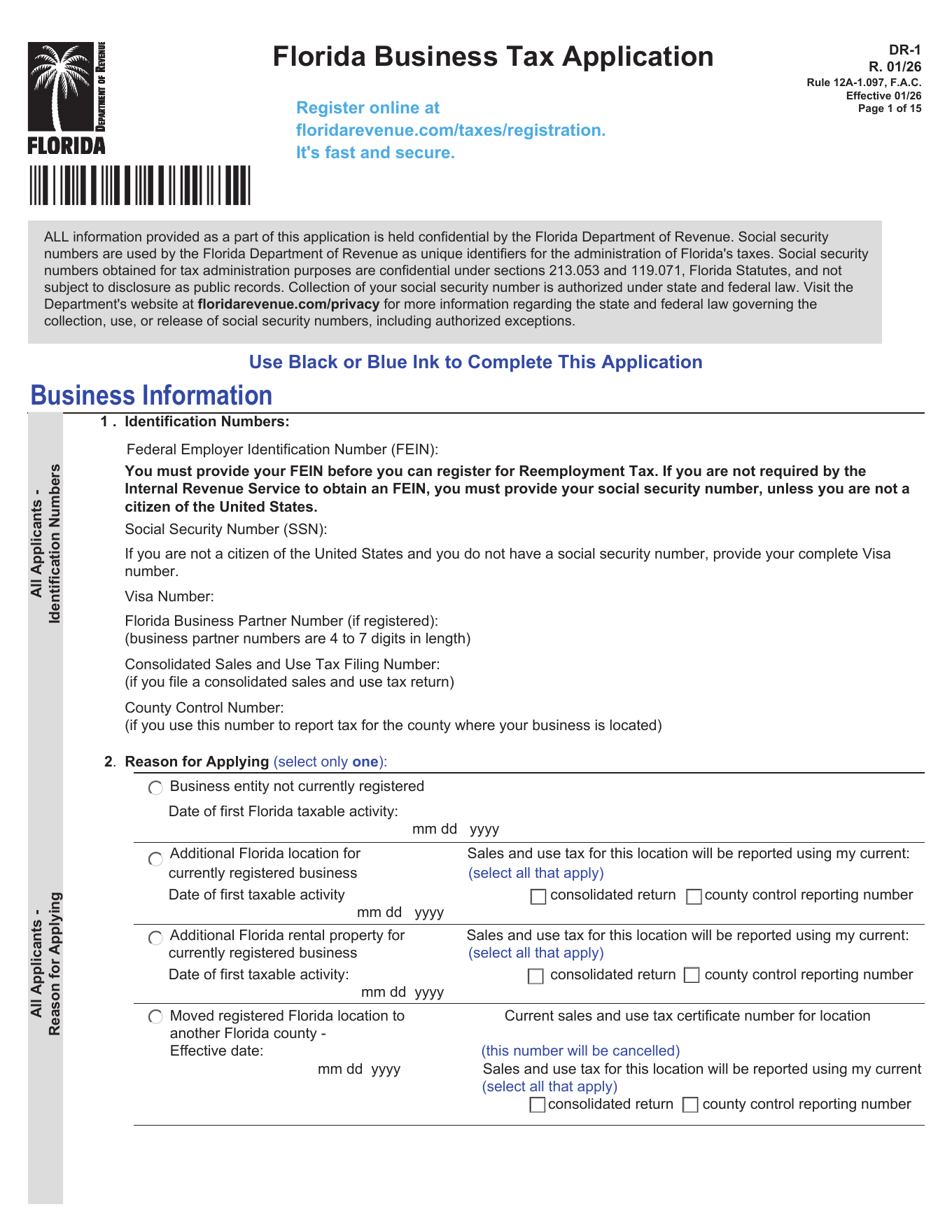
Remote sellers, marketplace providers, and marketplace sellers that also sell outside the marketplace can't use the paper form. Florida requires them to register electronically.
Warning: If you're applying to the Voluntary Disclosure Program, follow its instructions instead. The Department asks you not to register online and to send a completed Form DR-1 with your disclosure request, even if you'd otherwise have to register online.
Go to the Florida Business Tax Application login page. If you've already started an application, log in with your username and password. Otherwise, select Create User Profile.

On Create New User Profile, enter a username, an email address, and a password, each twice. The password must be 8 to 15 characters with at least one lowercase letter, one uppercase letter, one number, and one special character. Then select Create New User Profile.
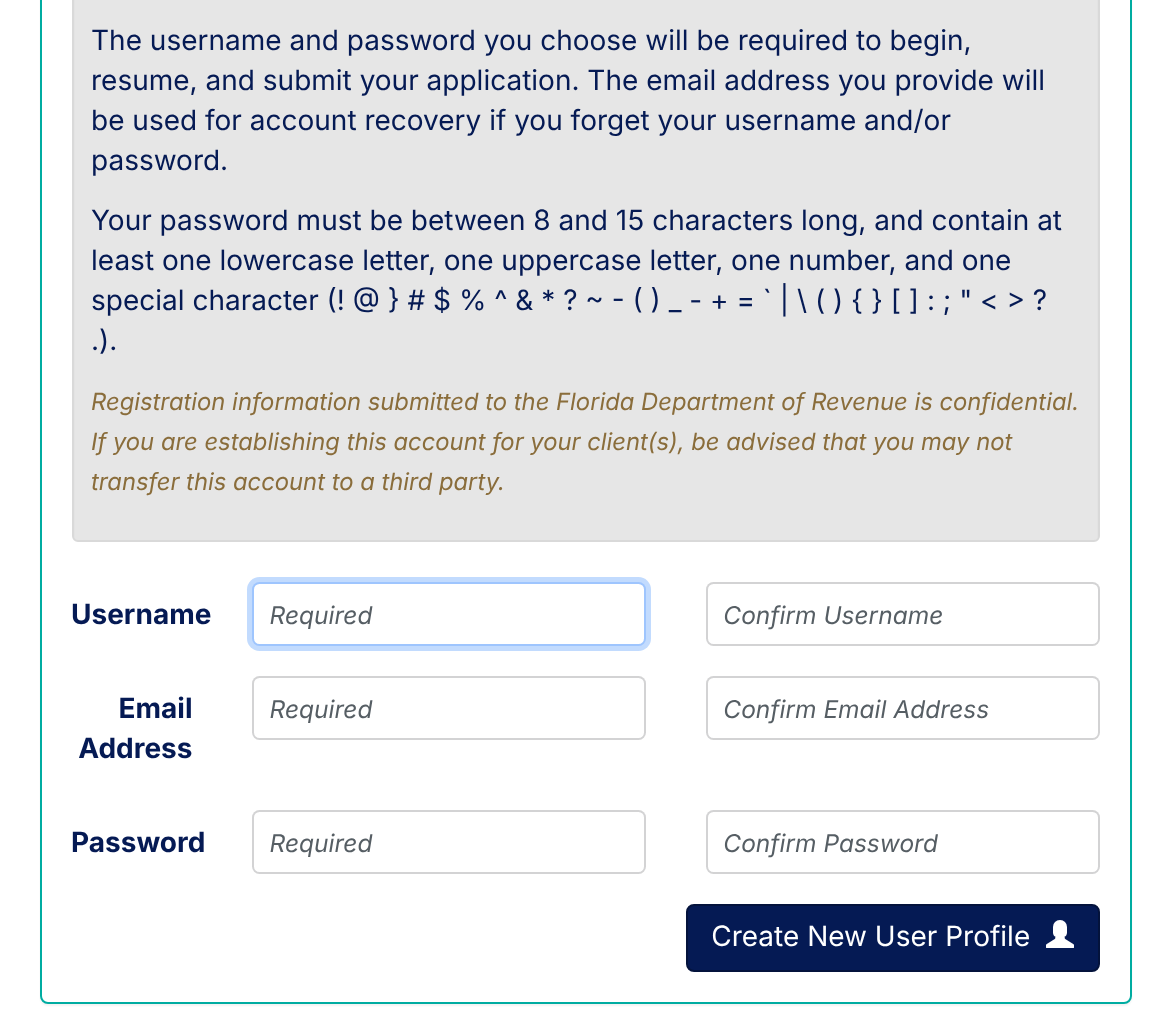
Tip: Keep your username and password. You need them to resume an unfinished application, check its status, and retrieve your certificate number. If you register for a client, the profile can't be transferred to them later.
On Reason for Applying, select New Registration if the business isn't registered with the Department yet. Enter the date of your first taxable activity in Florida.
The same list covers adding a location, moving a location to another county, changing ownership, and acquiring an existing business.
On Business Details, enter your legal business name, any trade name, and a phone number. Say whether the location is open only part of the year.
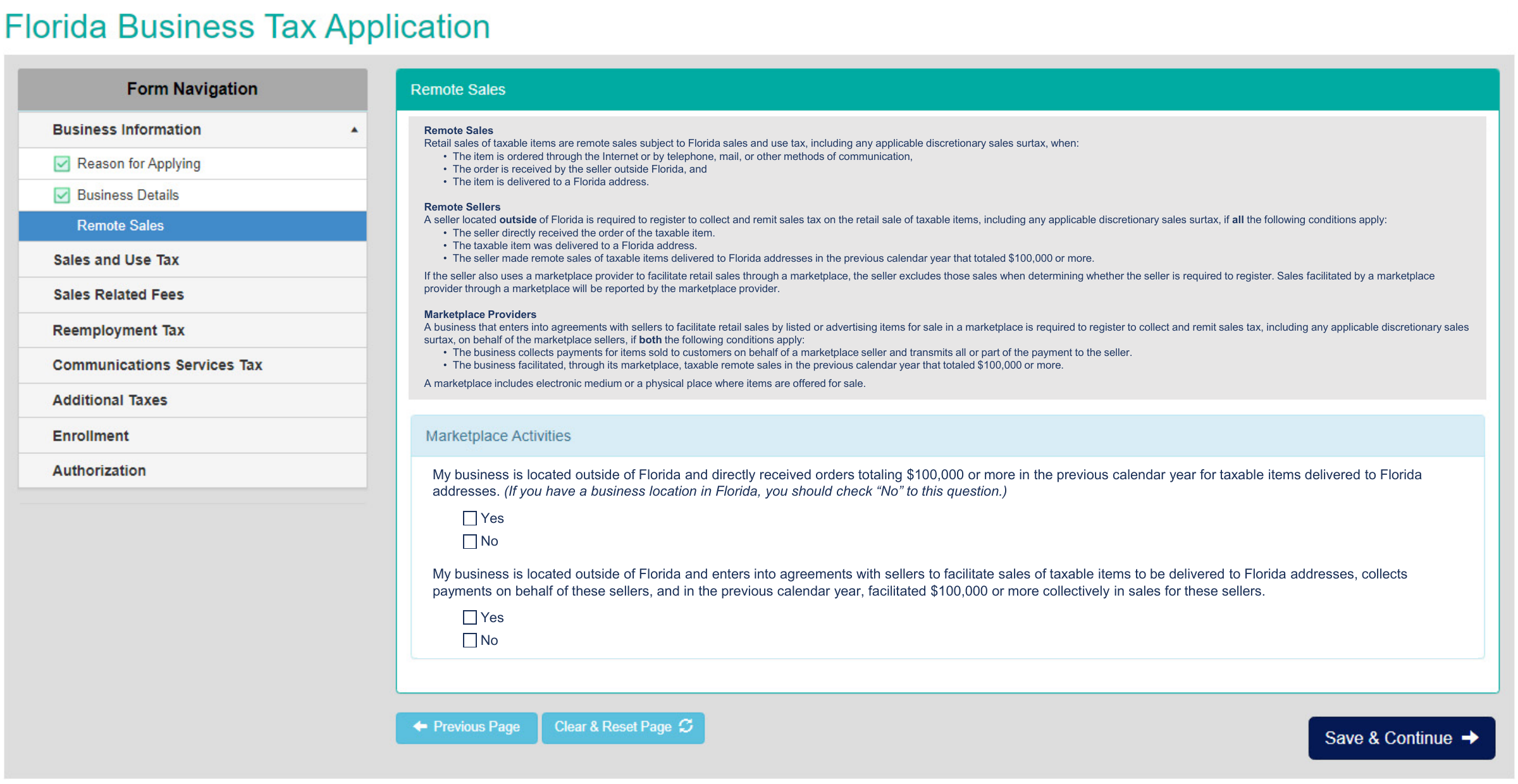
Next, the Remote Sales screen asks whether you're an out-of-state remote seller or marketplace provider. If you have a business location in Florida, the application tells you to answer No.
On Business Addresses, enter the physical street address and Florida county of the location, then the mailing address for returns and letters.
On Business Activity Reporting, choose to describe your business with NAICS codes (the preferred method) or a written description. With NAICS codes, the Business Activities screen asks for at least one 6-digit code, with your main activity first.
On Business Type, select your form of business ownership. Then enter each owner, partner, officer, or managing member, using the details from the checklist above.
Entities also enter their fiscal year-end. Every applicant says whether the business has been known by another name or held a Florida certificate before.
In the Sales and Use Tax section, check every activity that applies to the location, such as selling at retail, selling at wholesale, or selling from flea markets or craft shows.
The Sales Related Fees, Reemployment Tax, and other tax sections follow. Answer them so the Department can register you for any other taxes or fees that apply.
In Enrollment, you can enroll to file and pay electronically now or later. Remote sellers and marketplace providers must file and pay electronically either way.
Review the Application Summary, Declaration and Signature page, sign, and select Submit Application. There's no fee.
Allow 3 business days, then log back in to the Florida Business Tax Application to check the status and retrieve your certificate number.
The Department then mails a welcome package with your Certificate of Registration (Form DR-11), your Annual Resale Certificate (Form DR-13), a county surtax rate list, and a new dealer guide. The Certificate of Registration shows your certificate number on the front and your business partner number on the back.
Display the certificate where customers can see it. If you sell at flea markets or other temporary locations, keep it with you there.
A Florida Certificate of Registration is free, online or on paper. There's no charge for additional locations and no renewal fee.
Florida repealed its old $5 registration fee effective January 1, 2018, so guides that still mention it are out of date.
The $100 figure in Florida's registration law applies only to businesses that operate without registering. The law calls it a registration fee, and it is in addition to possible criminal penalties. The Department may waive it if the failure was due to reasonable cause.
The Department requires security only in specific cases, such as when the applicant:
For a new applicant, the usual amount is 6 months of estimated tax for a monthly filer, 9 months for a quarterly filer, and a year for semiannual or annual filers. The most it can require is 12 months of estimated tax plus any tax you already owe.
You can post a cash deposit, a surety bond, or an irrevocable letter of credit. The Department gives you 30 days from its notice to post security or request a conference. After 12 straight months of compliance, you can ask in writing for the security to be released.
For online applications, the Department says to allow 3 business days for processing before you check the status and retrieve your certificate number.
It doesn't publish processing times for paper applications or the mailed welcome package.
Florida issues two documents called certificates. They serve different purposes, and only one expires.
The Department issues a new Annual Resale Certificate each year to active registered dealers, meaning those required to file a return every period. It's available each November for the next year.
If you file electronically, you must print it yourself from the Department's Print Annual Resale Certificates page. You'll need the business partner number and certificate number from your Certificate of Registration. Paper filers get it by mail in mid-November.
If you register in mid-October or later, your first Annual Resale Certificate runs from the date it's issued through the end of the following year.
Tip: Businesses registered only to pay use tax don't receive an Annual Resale Certificate. If you plan to buy for resale, register to collect sales tax.
Florida issues a separate Certificate of Registration for each place of business, and each one covers a location in a single county. Most counties add a discretionary sales surtax of 0.5% to 2% to the 6% state rate, and you collect it based on the county where the sale is delivered.
With several locations, you can apply for a consolidated filing number (Form DR-1CON) and file one return for all of them. You can also get a county control reporting number (Form DR-1CCN) for the locations in a single county.
Out-of-state businesses submit one application for all their out-of-state locations. Remote sellers still collect surtax based on the Florida county where they deliver.
Charge Florida sales tax from the date of your first taxable activity: the 6% state rate plus any county surtax. Your first reporting period starts on the date you put on your application.
If you don't start business by that date, call the Department or file a return showing no tax due. Otherwise, you'll get a delinquency notice.
Most new businesses start on quarterly filing. After that, the Department reviews your account each year and sets your frequency from the tax you collect in a year:
The Department says remote sellers and marketplace providers must file and pay electronically every month.
You file Florida sales tax returns by the 1st of the month after each period, and they're late after the 20th. Electronic payments need a confirmation number by 5 p.m. ET on the business day before the 20th.
You must file every return, even when you owe nothing. A late return can cost a $50 minimum penalty even if no tax is due.
If you file and pay electronically on time, you can keep a collection allowance of 2.5% of the first $1,200 of tax due, up to $30.
Once you pay $5,000 or more in sales tax in a state fiscal year (July 1 to June 30), you have to file and pay electronically for the next calendar year, starting with the January return.
Florida doesn't require you to renew the Certificate of Registration. You must register again if your account was canceled or has been inactive for more than 2 years, if you change ownership or legal entity, move a location to another county, or start a new taxable activity at a registered location.
The Department can also revoke a certificate if you don't comply with the law.
Only the Annual Resale Certificate is reissued each year, as covered above. Registration rules in other states differ, and several require regular renewal.
It depends on your business type. Partnerships, corporations, and businesses with employees need a federal Employer Identification Number (FEIN).
Sole proprietors and individuals who are the only member of an LLC can register with a Social Security number. If you aren't eligible, you can provide a U.S. visa number.
No. An EIN is a federal tax ID from the IRS. The Certificate of Registration is the Department's authorization to collect Florida sales tax, and it comes with its own certificate number and business partner number.
Yes, if you'll make retail sales of taxable items there. Florida trade show exhibitors whose agreement allows retail sales have to register and collect tax.
Exhibitors that only take orders for resale or don't sell at all don't need to register. Flea market vendors keep their certificate with them at each temporary location.
It depends on where you're based. Out-of-state sellers don't need one if Amazon certifies that it collects Florida tax on their sales.
Sales through your own website aren't covered. If those direct sales top $100,000 in a calendar year, register and start collecting by Jan. 1 of the next year.
Florida-based sellers who sell only on Amazon should confirm with the Department or register to be safe. Florida law requires sellers with physical presence to register and collect tax on their sales outside the marketplace, but it doesn’t address sellers with no outside sales.
Yes. A certificate belongs to the owner it was issued to and can't be transferred. Register under the new ownership and list the business you acquired on the application.
You can also be held liable for the seller's unpaid Florida tax. Ask the seller for a Certificate of Compliance from the Department and hold back enough of the price to cover any amount due.
Register as soon as possible or apply to the Voluntary Disclosure Program if the Department hasn't contacted you yet. The Department looks back 3 years and waives penalties once you pay the tax and interest.
The exception is tax you collected but didn't remit, which carries a 5% penalty unless you show reasonable cause.
Without it, you may owe the $100 unregistered-business charge plus back tax, penalties, and interest.
Numeral is an end-to-end sales tax compliance platform for ecommerce and SaaS businesses. Top brands like Ridge, Muddy Bites, Graza, and Grüns spend less than five minutes a month on sales tax.
Learn more
