Florida's economic nexus threshold is $100,000 in taxable sales. Get a free nexus study. All 50 states covered.
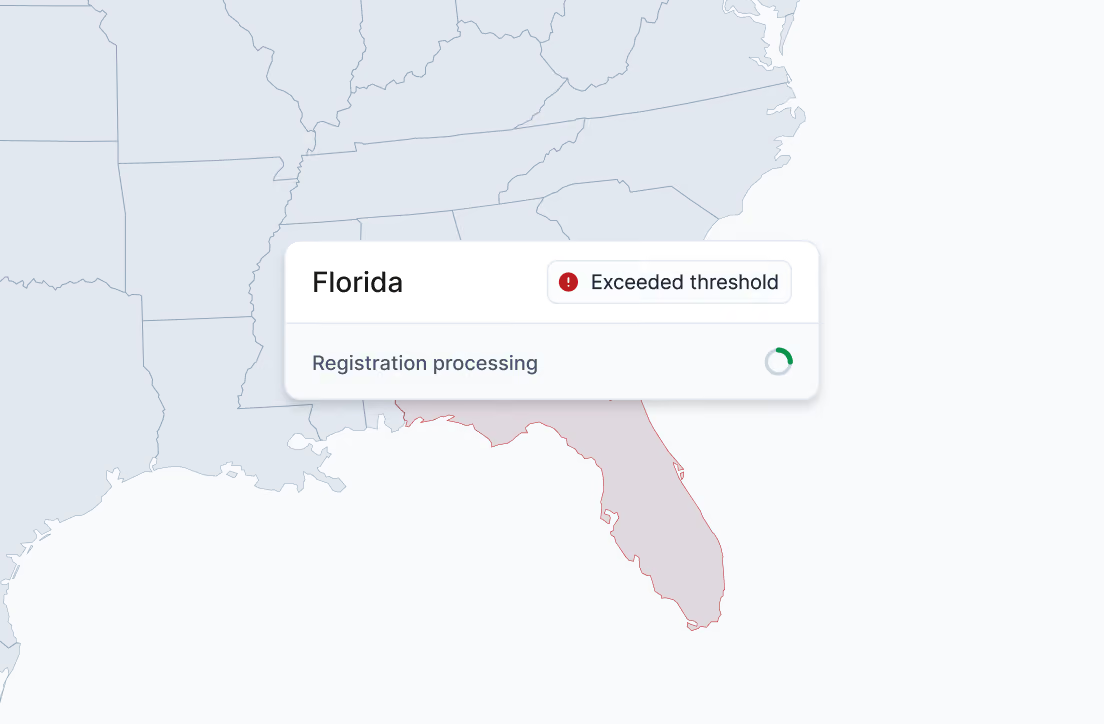
Florida's affiliate nexus rules operate through two distinct mechanisms under s. 212.06(2), F.S.
First, any corporation that belongs to an affiliated group as defined under IRC § 1504(a), F.S.) is treated as a "dealer" if any parent or subsidiary within that group has Florida nexus. This rule extends Florida's dealer obligations across the entire affiliated group whenever any member of the group is already subject to Florida sales tax.
Second, nexus is triggered when a related Florida entity performs activities that support the remote seller's Florida market. Qualifying activities under s. 212.06(2), F.S. include selling a similar product line under the same or substantially similar business name, maintaining an office, warehouse, or distribution facility in Florida to support delivery of the remote seller's goods, and delivering, installing, assembling, or performing maintenance services for the remote seller's Florida customers.
Physical presence in Florida creates immediate nexus regardless of the economic nexus threshold and independent of the $100,000 taxable sales figure. Under s. 212.06, F.S., the definition of "dealer" encompasses any business with a retail store, office, distribution center, warehouse, or any other place of business located in Florida. The presence of employees, agents, or representatives who sell, solicit orders, take orders, deliver merchandise, or service merchandise in Florida also constitutes physical nexus. Inventory stored at a Florida fulfillment center, including inventory held through Amazon FBA arrangements, creates nexus for the owner of that inventory. Soliciting business through in-state representatives or through catalog distribution directed at Florida customers similarly falls within the dealer definition.
Three specific circumstances do not create physical nexus under Florida's rules. Property stored at a Florida printer solely for printing purposes is excluded. A single isolated visit to a Florida customer where no sales orders are taken does not rise to the level of a place of business or regular in-state activity. A drop-shipment fulfilled by an out-of-state manufacturer and shipped directly to a Florida customer, where the seller has no other Florida presence, does not trigger nexus for the selling party.
Florida has no trailing nexus statute, regulation, or published Florida DOR guidance addressing how long collection obligations continue after a business falls below the economic nexus threshold or ends physical presence in the state. The structure of s. 212.0596, F.S. uses a prior-calendar-year look-back period, which means a business that falls below $100,000 in taxable Florida remote sales in a given year would not meet the threshold for the following calendar year. No published authority addresses the treatment of physical nexus obligations after in-state presence ends mid-year.
Lorem ipsum dolor sit amet, consectetur adipiscing elit. Suspendisse varius enim in eros elementum tristique. Duis cursus, mi quis viverra ornare, eros dolor interdum nulla, ut commodo diam libero vitae erat. Aenean faucibus nibh et justo cursus id rutrum lorem imperdiet. Nunc ut sem vitae risus tristique posuere.

