Yes. Although software as a service (SaaS) is not typically subject to sales tax in Illinois, it is taxable in the City of Chicago. This is due primarily to the Personal Property Lease Transaction Tax, or PPLTT.



| SaaS | |
|---|---|
| Digital Goods | |
| Confused? | Talk to us -> |
| Sales | $100,000 |
|---|---|
| Transactions | N/A |
| Physical? |
| Chicago | 15.00% |
|---|---|
| Average Total Rate | 15.00% |
| Local Rates Apply |
Chicago’s home rule authority allows the city to establish its own tax regulations, including those that apply specifically to SaaS. This article will explain SaaS taxability in Chicago, including what home rule cities are and how Chicago’s tax policies differ from state tax rules in Illinois.
Home rule cities, such as Chicago, operate under their own municipal charters rather than being governed solely by state statutes. Article VII, section 6 of the Illinois Constitution grants any municipality with a population higher than 25,000 the authority to create and enforce its own tax policies, including those that pertain to SaaS. Using this authority, Chicago imposes the PPLTT, even though SaaS is generally exempt from Illinois state tax.
Many regions in the U.S. exercise local tax authority. For example, Denver, Colorado, imposes a general sales and use tax of 5.15% (up from 4.81% as of January 1, 2026). This tax applies to the sale, lease, or rental of tangible personal property and certain services.
In general, home rule cities can present significant challenges for SaaS providers, as businesses must account for varying rules not only at the state level but also in each individual jurisdiction where they operate.
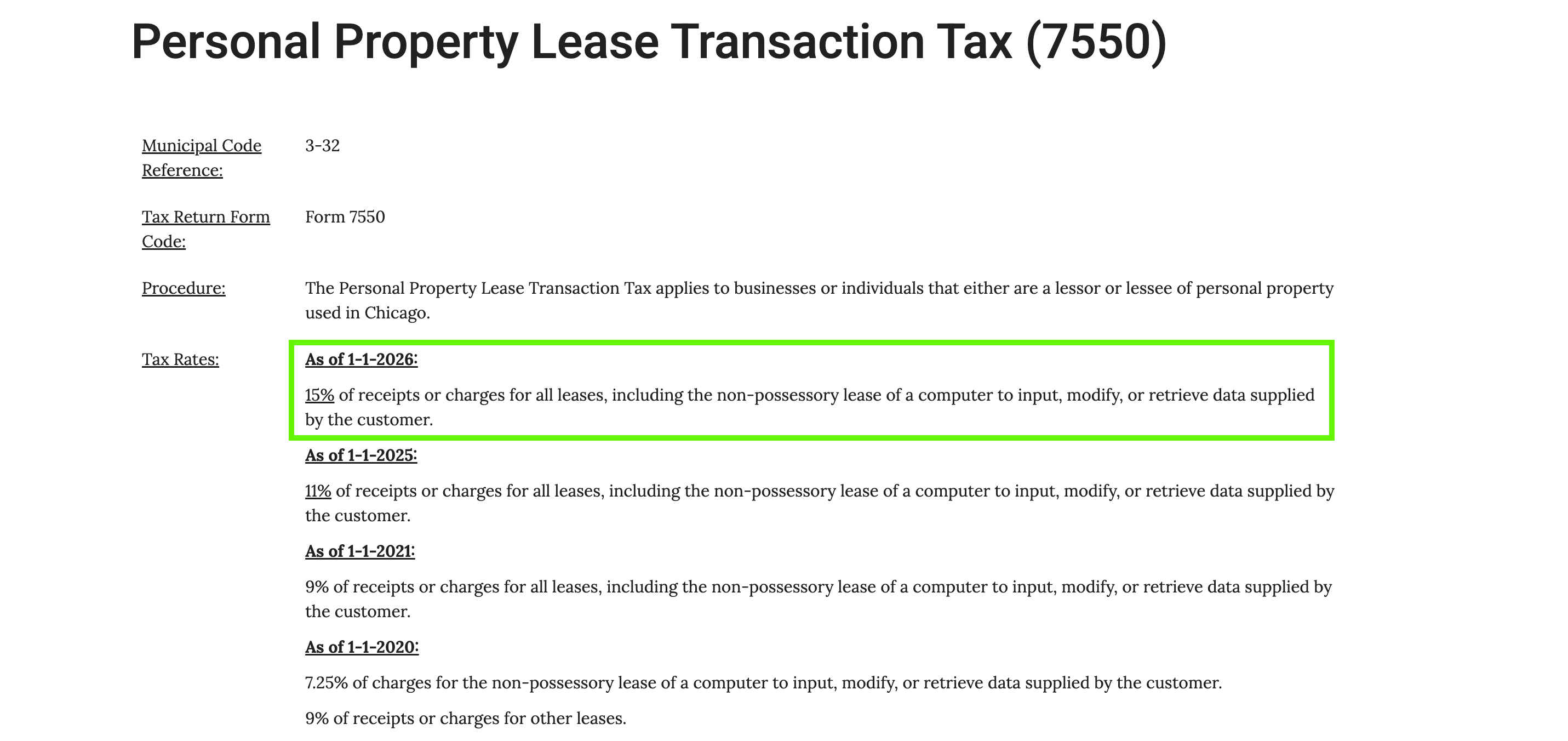
The City of Chicago applies the PPLTT to the use of personal property that is leased or rented, including non-possessory computer leases. SaaS is subject to this tax because Chicago considers accessing software hosted on a provider’s server to be a lease of personal property. While the lease transaction rate was set at 11% in 2025, as of January 1, 2026, SaaS providers in the City of Chicago may be taxed at a rate of 15%.
Whether a SaaS provider in Chicago has to collect and remit taxes can depend on whether they have nexus there. According to Chicago’s Departments of Finance and Law, there are two main types of nexus: physical and economic.
Even if a SaaS provider is fully remote and has no physical presence in the city, it must carefully track all transactions within Chicago to see whether economic nexus thresholds are reached. If a business has nexus in Chicago and the correct tax amounts are not collected and remitted, it could face severe consequences.
In Chicago, SaaS is defined under the PPLTT as a “non-possessory computer lease.” This means that when customers remotely access software hosted on a provider’s server to input, modify, or retrieve data, it is considered a taxable transaction. Chicago’s tax code treats SaaS as a lease of personal property rather than the purchase of software, which aligns with the city’s interpretation of non-possessory computer use. According to this definition, numerous types of SaaS products are considered taxable, including:
These and many other platforms are subject to tax because they involve remote access to software, even though ownership is not transferred to the user. However, customer software and cloud storage services that do not meet Chicago’s definition of SaaS may be exempt.
If software is created specifically for a client and installed directly on their system, it would not be considered a “non-possessory computer lease.” Cloud storage services, on the other hand, may or may not be taxed depending on how users remotely access their data. Providers should reach out to the Chicago Department of Finance or consult with a tax attorney to determine whether their specific products are subject to sales tax.
At the state level, Illinois does not generally impose sales tax on SaaS because it classifies SaaS as a service rather than as tangible personal property. Because Illinois sales tax is primarily applied to the sale or lease of personal property, most digital and cloud-based services are excluded. In Chicago, however, SaaS is subject to a PPLTT tax of 15%.
Chicago’s tax policy impacts both local and remote SaaS providers. Whether a provider has a physical presence in Chicago or reaches the economic nexus threshold of $100,000 yearly revenue from customers in Chicago, it must collect and remit sales tax. This can involve several steps:
Companies that don’t follow these steps and deal with the many other aspects of compliance may be subject to fines, interest, and a higher risk of audits. In some cases, SaaS providers can lose their ability to operate in Chicago altogether.
Tax compliance platforms like Numeral, as well as resources provided by Chicago’s Department of Finance, can help SaaS businesses easily manage sales tax obligations and avoid errors that may lead to fines and other penalties.
[inline-cta title="Let us worry about sales tax." text="The trusted solution for U.S. sales tax, VAT, and GST compliance, used by 3,500+ global businesses. " button="Get started for free" button-link="/get-started"]
Despite its exemption from Illinois state taxes, SaaS can be subject to tax in Chicago. This is due to Chicago’s status as a home rule city, which gives it the authority to set its own tax policies. One specific tax that SaaS providers may encounter is the Personal Property Lease Transaction Tax. or PPLTT. As of January 1, 2026, this tax is set at a rate of 15%. Any SaaS product that falls under Chicago’s definition of a non-possessory computer lease may be subject to this tax.
This is one of the numerous aspects of sales tax compliance that SaaS providers will need to attend to; other responsibilities include determining nexus, registering with the city, filing sales tax returns, and remitting the correct amount of taxes. These processes can be made much easier with the help of tax compliance platforms like Numeral, alongside resources provided by Chicago’s tax authority, the Department of Finance.
The trusted solution for U.S. sales tax, VAT, and GST compliance, used by 3,500+ global businesses.