New Jersey sales tax registration gets you a Certificate of Authority from the New Jersey Division of Taxation. You apply on Form NJ-REG with the Division of Revenue and Enterprise Services, online or on paper, and there's no fee. Remote sellers need to register once their New Jersey sales top $100,000 or 200 transactions in the current or prior calendar year.
You need a New Jersey Certificate of Authority for Sales Tax if you sell taxable goods or services in New Jersey and you have nexus there, either through a physical presence or by crossing the sales threshold.
Businesses with a physical presence must register at least 15 business days before starting. Remote sellers get a grace period, covered below.
You register by filing a Business Registration Application (Form NJ-REG) with the New Jersey Division of Revenue and Enterprise Services (DORES). If you'll collect sales tax, the New Jersey Division of Taxation issues the certificate that authorizes you to collect it.
There is no sales tax on SaaS in New Jersey, unless it's used to deliver an information service. If nontaxable SaaS is all you sell, you have no New Jersey sales tax to collect.
You may still need to register. Businesses with a New Jersey presence file NJ-REG regardless. Remote sellers whose sales are all nontaxable don't need to register, as covered below.
If you have no physical presence in New Jersey, you need to register once you cross the New Jersey economic nexus threshold. You meet it at either of these levels in the current or prior calendar year:
Out-of-state sellers can also have nexus through New Jersey independent contractors or representatives who refer customers for a commission. Once those referral sales top $10,000 over the prior four quarters, you're presumed to have nexus and must register, unless you can show they didn't solicit for you.
Count these sales when they're delivered into New Jersey:
If every New Jersey sale you make is for resale or otherwise nontaxable, you don't need to register.
Once you cross the threshold, you have up to 30 days to register and start collecting. You don't collect tax on the sale that pushes you over.
The requirement then runs for the rest of that year and all of the next. For example, if you cross the threshold in May, you have up to 30 days to start collecting, and you keep collecting through Dec. 31 of the following year.
If you crossed the threshold in an earlier year and never registered, a voluntary disclosure agreement can limit what you owe.
New Jersey's Voluntary Disclosure Program may waive some or all penalties and limit the look-back period for businesses. You qualify only if the Division hasn't contacted you and you aren't registered for the tax.
Interest still applies. A 5% penalty also applies to any sales tax you collected but didn't remit.
If you have physical nexus in New Jersey, you need to register at least 15 business days before you start doing business there, regardless of your sales volume. The $100,000 and 200-transaction thresholds don't apply.
These create physical presence:
That includes sellers whose only New Jersey presence is inventory in a marketplace warehouse, covered in the next section.
New Jersey's marketplace facilitator law makes marketplaces collect and remit New Jersey sales tax on every sale they facilitate, regardless of whether the seller is above or below the threshold. You don't collect tax on those sales.
New Jersey counts marketplace sales toward a remote seller's threshold. Whether you need your own Certificate of Authority depends on your presence in New Jersey:
Storing inventory in a marketplace's New Jersey warehouse gives you physical presence in New Jersey. The Division counts storing inventory at a New Jersey location "regardless of ownership of the facility." That covers Amazon FBA sellers with stock in a New Jersey fulfillment center.
If you store inventory in New Jersey, you need to register before making New Jersey sales, regardless of your sales volume, even if every sale goes through the marketplace.
The marketplace still collects the tax on its sales, but you file returns. Form C-6205-ST’s marketplace option, which lets sellers skip filing, is only for remote sellers.
Inventory also rules out the online Register as Remote Seller only option, which is only for businesses with no physical presence. Numeral’s guide to New Jersey sales tax nexus provides more detail.
Corporations, LLCs, limited partnerships, and LLPs must form or authorize their business with DORES before they register for taxes. That Business Formation, or Public Records Filing, has a fee and gives you a 10-digit Business Entity ID. File NJ-REG within 60 days of forming a new entity.
Sole proprietorships and general partnerships skip that step. So do businesses that choose: Register as Remote Seller only.
The checklists below follow the online filing requirements and the paper Form NJ-REG, which asks the same questions.
For the owner, each partner, or each responsible corporate officer, you'll need:
The sales tax questions on Form NJ-REG ask:
Other questions cover employees, cigarettes and tobacco, litter-generating products, new tires and motor vehicles, and hotel or short-term rentals.

Most businesses register online through DORES's Business and Employer Registration service.
You can also complete the paper Form NJ-REG and upload it through DORES's online fax filing service, or mail it to DORES Client Registration, P.O. Box 252, Trenton, NJ 08646-0252.

Remote sellers registering in several states can use the Streamlined Sales Tax Registration System instead, since New Jersey is a full Streamlined member.
On the Business and Employer Registration page, open Filing Requirements to check what you'll need, then select Get Started.

A notice asks whether you've already filed your Business Formation. If you're a corporation or LLC that hasn't, file it first through Online Formations. Otherwise, select Continue.
On the Start Registration screen, choose the option that fits your business:

Select Continue.
Follow the prompts through the Business Information, Ownership Information, Business Classification, and Contact Information sections. The application asks for the details in the checklists above:
Check everything on the Review page, use the edit buttons to fix anything wrong, and submit. There's no fee to register.
Warning: The application can't be saved. If you close your browser or leave it inactive for 30 minutes, everything you entered is lost and you have to start over.
When you submit, the confirmation page links to a copy of your application and, if you registered to collect sales tax, your Sales Tax Certificate of Authority. DORES also emails you the link and an access key.
Download the Certificate of Authority right away. The link works for 30 days, and DORES doesn't mail a copy of online registrations. After 30 days, you'll need to call DORES at 609-292-9292 for a new copy.
Your Business Registration Certificate (BRC) is separate. You can download it starting two business days after you register, and DORES mails it within 10 business days.
Your New Jersey tax ID is your FEIN or Social Security number plus a three-digit suffix of 000. Use it on all returns, payments, and correspondence.
Remote sellers who register through the remote seller option or the Streamlined system get a letter with filing and payment information.
A Certificate of Authority is free. There's no fee for filing Form NJ-REG, online or on paper, and no renewal fee.
Corporations, LLCs, limited partnerships, and LLPs do pay a fee for their Business Formation, which they file before NJ-REG. That's a fee for creating or authorizing the entity, not for the sales tax registration.
If you register online and qualify, you can download your Certificate of Authority from the confirmation page as soon as you submit. Your BRC is available to download two business days later and arrives by mail within 10 business days.
DORES doesn't publish a processing time for paper NJ-REG applications. Since you must register at least 15 business days before starting business, mail or upload a paper form well ahead of your first sale.
Once you're registered, you have to file a sales tax return every quarter, even when you owe nothing. Some registrants can ask DORES to stop requiring returns by filing Form C-6205-ST, Request to Be Placed on a Non-Reporting Basis. It's open to:
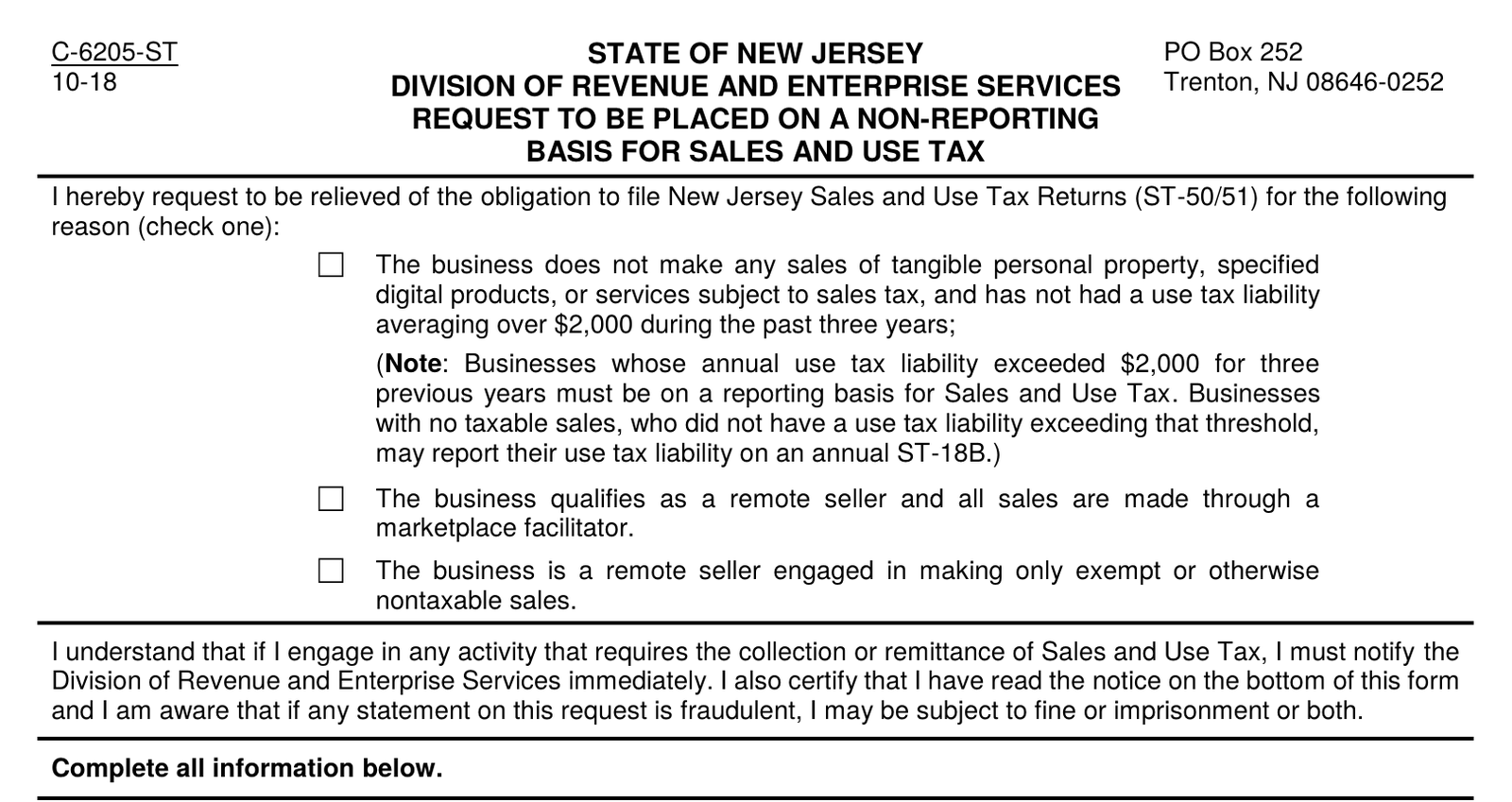
Mail the completed form to DORES at P.O. Box 252, Trenton, NJ 08646-0252. If you later start making sales that require you to collect or remit tax, you must notify DORES immediately.
Vendors at New Jersey flea markets, craft shows, and trade shows must register like any other seller, including one-time vendors. Register at least 15 business days before the event.
New Jersey has no special provisions for temporary vendors. Once registered, you file every required return until you end your registration.
Seasonal businesses list the months they're open on NJ-REG and file only for those periods. If you're active for even one month of a quarter, you file that quarter's return.
At every event, display both your Business Registration Certificate and your Certificate of Authority. That applies even at events where you complete sales online or off-site.
Display your Certificate of Authority and your Business Registration Certificate at all times at your place of business. The Certificate of Authority must be where customers can see it.
Charge New Jersey sales tax at the statewide rate of 6.625% on taxable sales delivered to New Jersey. Some sales in Atlantic City, Cape May County, and Salem County have their own local taxes or rates.
Businesses subject to them also file a monthly local return electronically: Form ST-250 for the Atlantic City luxury tax, Form ST-350 for the Cape May County tourism tax, or Form ST-450 for Salem County.
Your certificate also lets you issue and accept New Jersey exemption certificates, such as Form ST-3 for resale.
Registered sellers file quarterly on Form ST-50, unless DORES has placed them on a non-reporting basis. Larger sellers also make monthly payments:
You file New Jersey sales tax electronically, online or by phone. Returns and monthly statements are due by the 20th of the month after the period ends.
Quarterly returns are due April 20, July 20, Oct. 20, and Jan. 20. File the ST-50 every quarter, even if no tax is due.
You don't renew a Certificate of Authority. Once registered, you file every required return until you properly end your registration.
If you sell or close the business, file a final return, submit Form REG-C-L, and return your certificates to DORES. If you don't, you may get delinquency notices for unfiled returns.
Registration rules differ by state, and several require renewal.
No. The Certificate of Authority for Sales Tax (Form CA-1) lets you collect New Jersey sales tax. A general certificate of authority from DORES lets an out-of-state corporation do business in New Jersey.
An out-of-state corporation or LLC with a New Jersey presence may need both. It gets authorized through Online Formations first, then registers for sales tax on NJ-REG.
No, but they're linked. An EIN, or FEIN, is your federal tax ID from the IRS. Your New Jersey taxpayer ID is your 12-digit number: your EIN or Social Security number plus a three-digit suffix.
Your EIN also isn't your Business Entity ID. That's a 10-digit number DORES assigns when you form an entity.
It depends on your business type:
No. Your Certificate of Authority shows you're registered to collect New Jersey sales tax. A resale certificate, Form ST-3, is what you give a supplier when you buy goods to resell.
You need to be registered to use a resale certificate. A New Jersey seller must be registered to accept exemption certificates, and the NJ-REG question on exempt purchases is how you're set up to issue them.
It depends on your presence in New Jersey and your sales volume:
Yes. When ownership changes, the new owner registers with DORES. The seller ends its registration and returns its certificates, noting you as the successor.
Before the sale, you or your attorney must send the Division Form C-9600 with the required documents at least 10 business days in advance. That keeps you from inheriting the seller's unpaid New Jersey taxes.
Numeral is an end-to-end sales tax compliance platform for ecommerce and SaaS businesses. Top brands like Ridge, Muddy Bites, Graza, and Grüns spend less than five minutes a month on sales tax.
Learn more
