Utah's economic nexus threshold is $100,000 in sales. Get a free nexus study. All 50 states covered.
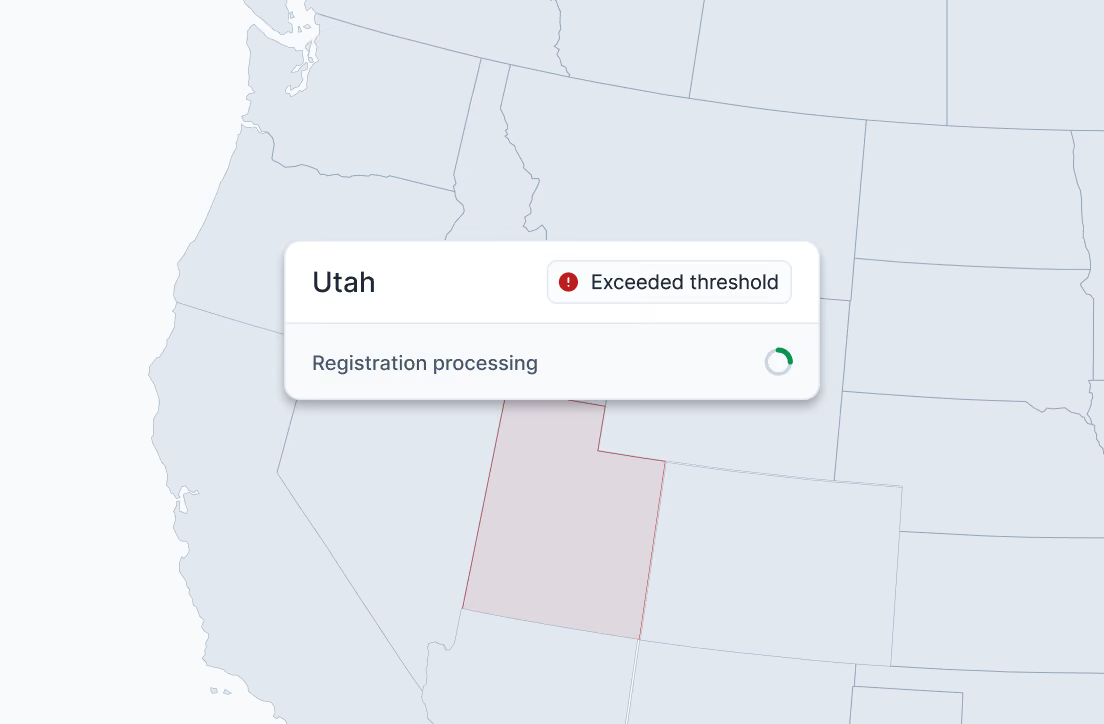
Utah's affiliate nexus rule requires two conditions to be satisfied simultaneously. The first is an ownership condition: the remote seller must hold more than 10% interest in a related entity with Utah physical presence, or vice versa, or a related entity wholly owns the remote seller. The second is an operational link: either the seller sells the same or substantially similar product line under the same or substantially similar business name as the Utah-based entity, or the Utah entity's place of business or employees are used to advertise, promote, or assist the remote seller's Utah sales. Both conditions must be present at the same time. Satisfying only one is insufficient to establish affiliate nexus. Utah does not have a standalone click-through nexus statute.
Under Utah Code Ann. Title 59, Chapter 12 and Utah State Tax Commission Pub 37, physical presence in Utah triggers an immediate registration obligation regardless of sales volume. Presence is established by maintaining any office, distribution house, sales house, warehouse, service enterprise, or other place of business in the state. Owning, leasing, or maintaining inventory in Utah creates nexus, including inventory held through fulfillment networks. No FBA safe harbor exists under Utah law. Having any employee in Utah establishes nexus, including employees whose duties are non-sales in nature. Regularly delivering property in Utah other than by common carrier or U.S. mail, regularly leasing, servicing, repairing, or maintaining property in Utah, and performing or supervising installation work in Utah each independently create physical nexus. Solicitation conducted exclusively by direct mail, email, internet, telephone, or similar remote means does not on its own trigger physical nexus. Regarding trade shows and special events: exhibiting at a Utah special event for more than six months results in loss of remote seller status. Exhibiting for six months or fewer without making sales does not create nexus. All vendors at special events are required to obtain a Temporary Sales Tax License (Form TC-790C).
Utah's calendar-year evaluation period creates a built-in 12-month trailing period for economic nexus. A business that exceeds $100,000 in gross Utah sales in a given calendar year has nexus for the entirety of the following calendar year, even if sales in that subsequent year fall below the threshold. Nexus lapses only at the close of that subsequent year if sales during it also remain below $100,000. For physical nexus, Utah does not publish a specific trailing period after physical presence is removed.
Lorem ipsum dolor sit amet, consectetur adipiscing elit. Suspendisse varius enim in eros elementum tristique. Duis cursus, mi quis viverra ornare, eros dolor interdum nulla, ut commodo diam libero vitae erat. Aenean faucibus nibh et justo cursus id rutrum lorem imperdiet. Nunc ut sem vitae risus tristique posuere.

