Ohio's economic nexus threshold is $100,000 in sales or 200 transactions. Get a free nexus study. All 50 states covered.
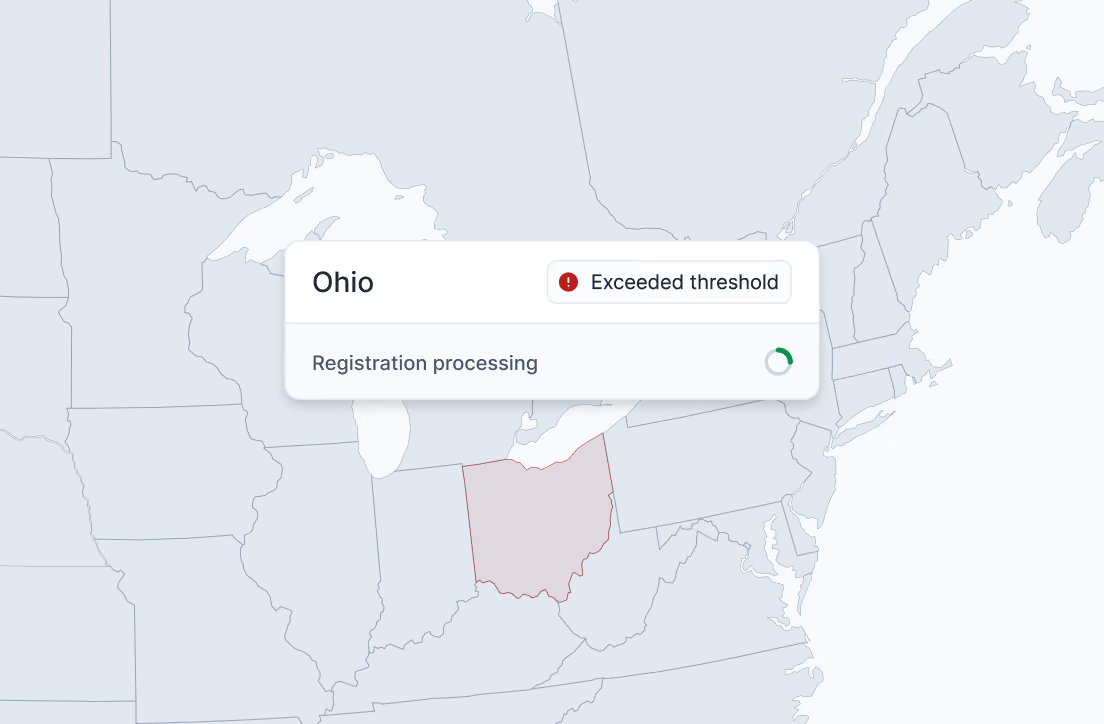
Ohio recognizes two distinct categories of nexus that arise through relationships with in-state persons or affiliated entities, both codified under ORC § 5741.01(I).
Affiliate nexus arises when a remote seller has an affiliated person with substantial Ohio nexus. An "affiliated person" is defined as a member of the same controlled group under IRC § 1563(a), or any entity with 50% or more common ownership with the remote seller. The existence of such an affiliation creates a presumption of substantial nexus for the remote seller.
Representative nexus arises when a remote seller uses any person located in Ohio, other than a common carrier, to receive or process orders, or uses that person's Ohio employees or facilities to advertise, promote, or facilitate sales into the state. This provision replaced the prior commission-based click-through nexus rule and applies more broadly to any in-state representative arrangement regardless of whether compensation is contingent on Ohio sales.
Both the affiliate nexus presumption and the representative nexus presumption are rebuttable. A seller can overcome either presumption by demonstrating that the in-state activities are not significantly associated with the seller's ability to establish or maintain an Ohio market.
Ohio's physical nexus rules are codified under ORC § 5741.01(I)(2)(a), which define the circumstances under which a seller is considered to have substantial nexus through physical presence in the state.
Physical nexus is established by using an office, distribution facility, warehouse, storage facility, or similar place of business in Ohio, whether the location is operated directly or through a subsidiary. It also arises from regularly using employees, agents, representatives, solicitors, installers, repairers, or salespersons in Ohio for business purposes; what qualifies as "regularly used" is determined based on facts and circumstances.
Additional triggers include making regular deliveries into Ohio by means other than a common carrier, such as deliveries in company-owned vehicles. Shipping via common carriers such as UPS, FedEx, or USPS does not create physical nexus.
All physical nexus presumptions are rebuttable by demonstrating that the in-state activities are not significantly associated with establishing or maintaining an Ohio market.
Ohio has no explicit trailing nexus statute governing the end of physical presence obligations. For physical nexus, obligations generally cease when the triggering physical activity ends.
For economic nexus, the dual lookback structure creates an implicit trailing effect. A seller that exceeded the threshold in Year 1 remains obligated through all of Year 2 because the preceding calendar year prong of the evaluation continues to be satisfied. Nexus under the economic standard ceases only when sales fall below the threshold in both the current calendar year and the most recently completed calendar year.
Lorem ipsum dolor sit amet, consectetur adipiscing elit. Suspendisse varius enim in eros elementum tristique. Duis cursus, mi quis viverra ornare, eros dolor interdum nulla, ut commodo diam libero vitae erat. Aenean faucibus nibh et justo cursus id rutrum lorem imperdiet. Nunc ut sem vitae risus tristique posuere.

