Maryland's economic nexus threshold is $100,000 in sales. Get a free nexus study. All 50 states covered.
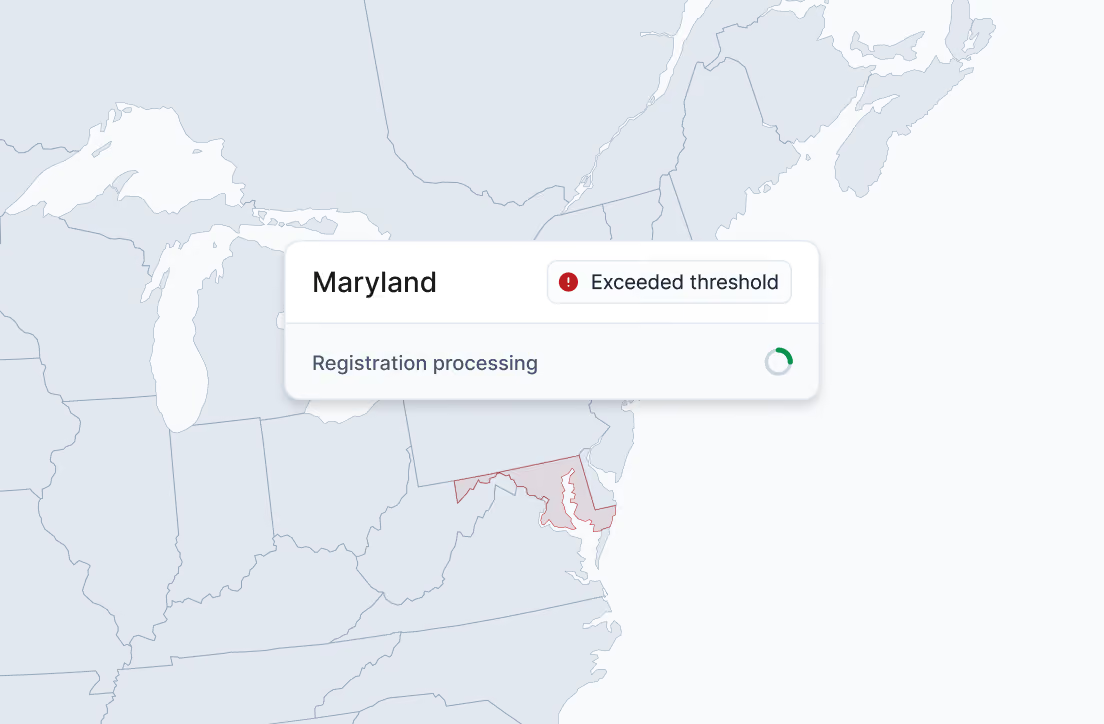
Maryland's click-through affiliate nexus standard has been in place since June 1, 2009, codified at Md. Code Ann., Tax-Gen. § 11-701.1. Under that provision, a remote seller is presumed to have a nexus-creating agent in Maryland when two conditions are both met: the seller has an agreement with a Maryland resident who refers customers to the seller (including through an internet link) in exchange for a commission, and the cumulative gross receipts from referred Maryland customers exceed $10,000 during the preceding four quarterly periods, with quarters ending on the last day of February, May, August, and November. This presumption is rebuttable.
A broader nexus basis also exists under the physical nexus statute. Md. Code Ann., Tax-Gen. § 11-701(b)(2)(i) establishes nexus for any activity conducted directly or through an agent or subsidiary, meaning a remote seller whose in-state affiliate or subsidiary conducts business activity in Maryland may establish nexus under that provision independent of the click-through threshold.
Physical nexus in Maryland is governed by Md. Code Ann., Tax-Gen. §§ 11-701(b)(2)(i)-(iii) and COMAR 03.06.01.33(B)(4). A business establishes nexus by permanently or temporarily maintaining, occupying, or using any office, sales or sample room, distribution center, storage facility, warehouse, or other place of business in Maryland, whether directly or through an agent or subsidiary. Having any agent, canvasser, representative, salesman, or solicitor operating in the state also creates nexus, as does maintaining inventory in a public warehouse in Maryland.
Service-related presence creates nexus when a business enters Maryland on a regular basis to provide service, repair, or installation for tangible personal property. Under this standard, "regular basis" means activity that is customary, usual, or in the normal course of business; infrequent or discretionary visits do not qualify. Regularly using company-owned vehicles to sell or deliver tangible personal property in Maryland is an independent nexus trigger.
An exception applies under Md. Code, Public Safety § 14-219 for out-of-state businesses performing disaster- or emergency-related work. Protection begins 10 days before a declared emergency and extends 60 days after the emergency ends, provided the business had no prior Maryland nexus.
Maryland has no formally named trailing nexus policy, but two functional mechanisms produce a trailing obligation. First, the calendar-year evaluation period means that a seller who met either the $100,000 or 200-transaction threshold in the prior calendar year remains obligated to collect and remit throughout the entire current year, even if current-year activity is trending below the threshold. Second, formal termination of the registration obligation requires submission of Form 202FR to the Maryland Comptroller's Compliance Division. Maryland actively enforces nexus obligations through a dedicated Nexus Unit.
Lorem ipsum dolor sit amet, consectetur adipiscing elit. Suspendisse varius enim in eros elementum tristique. Duis cursus, mi quis viverra ornare, eros dolor interdum nulla, ut commodo diam libero vitae erat. Aenean faucibus nibh et justo cursus id rutrum lorem imperdiet. Nunc ut sem vitae risus tristique posuere.

