Kentucky's economic nexus threshold is $100,000 in sales or 200 transactions. Get a free nexus study. All 50 states covered.
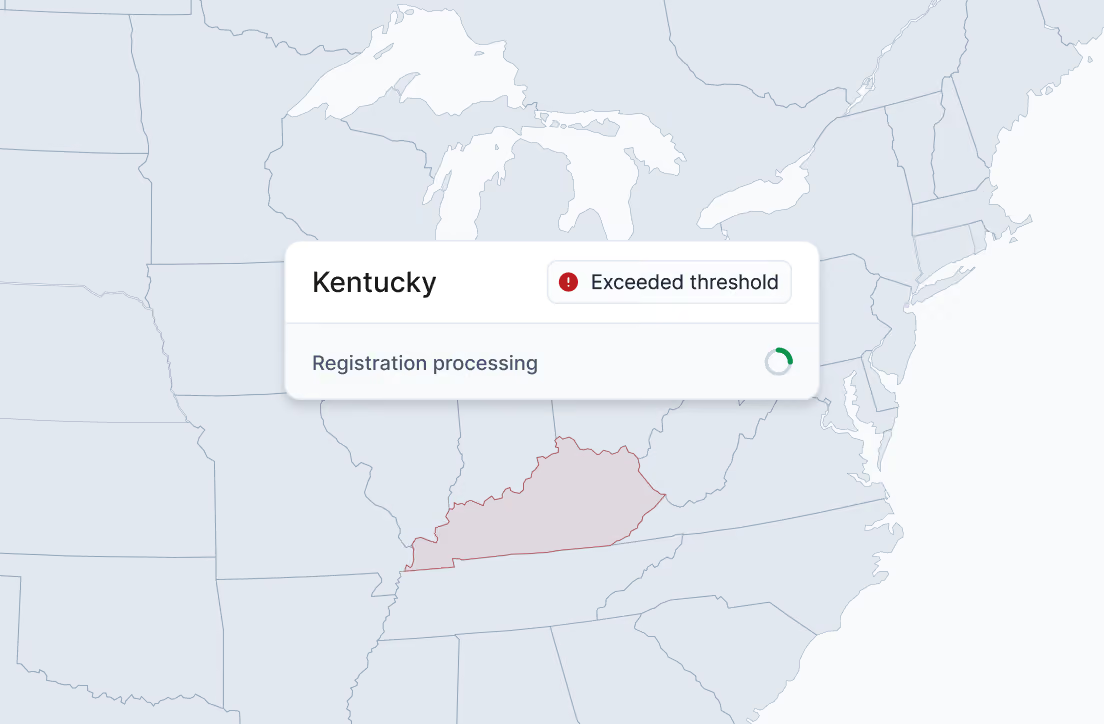
Kentucky does not have a standalone affiliate nexus statute. Affiliate relationships are instead addressed within the broader physical nexus framework of KRS 139.340(2), which defines a retailer as engaged in business in Kentucky when it maintains any office, place of business, warehouse, or other facility, or uses any representative, agent, or solicitor, directly or indirectly through a subsidiary, related entity, representative, or agent.
This structure means that physical presence established by a subsidiary or related in-state entity triggers nexus for the parent or associated retailer. A marketplace provider is explicitly defined to include any affiliate of the facilitating entity, ensuring that affiliate relationships within a marketplace structure do not create a gap in coverage. Kentucky never enacted a standalone click-through nexus statute; however, the statute's broad representative and agent language functionally captures referral arrangements that direct Kentucky customers to a remote seller.
Under KRS 139.340(2), a retailer is engaged in business in Kentucky, and therefore has physical nexus, when it maintains, permanently or temporarily, any office, place of distribution, sales or sample room, warehouse, storage place, or other place of business in the state. The statute applies whether the facility is maintained directly or indirectly through a subsidiary, related entity, representative, or agent.
Physical nexus also arises when a business has any representative, agent, salesman, canvasser, or solicitor operating in Kentucky for the purpose of selling, delivering, or taking orders. An agent or representative who repairs or services tangible personal property sold by the retailer in Kentucky independently creates nexus under this provision.
Kentucky's statute additionally covers businesses that systematically solicit orders from Kentucky customers on a continuous, regular, or systematic basis through Kentucky-based financial institutions, telecommunications providers, radio, television, cable, or print media.
Inventory held in a Kentucky fulfillment center or warehouse — including inventory stored through third-party fulfillment programs such as Amazon FBA — creates physical nexus. The statute contains no exclusion for inventory held by third-party facilities on a retailer's behalf.
Kentucky statute explicitly carves out one scenario that does not create nexus: contracting with an unrelated Kentucky printer does not, by itself, establish physical presence in the state.
Kentucky has no formal statutory trailing nexus period. Per the Streamlined Sales Tax Taxability Matrix, Kentucky does not provide a statutory provision for cancellation of registration as long as sales continue to be sourced into the state. No fixed trailing period applies; deregistration is subject to an administrative determination by the Kentucky Department of Revenue based on whether sales into the state have ceased or fallen to a level that no longer warrants active registration.
Lorem ipsum dolor sit amet, consectetur adipiscing elit. Suspendisse varius enim in eros elementum tristique. Duis cursus, mi quis viverra ornare, eros dolor interdum nulla, ut commodo diam libero vitae erat. Aenean faucibus nibh et justo cursus id rutrum lorem imperdiet. Nunc ut sem vitae risus tristique posuere.

