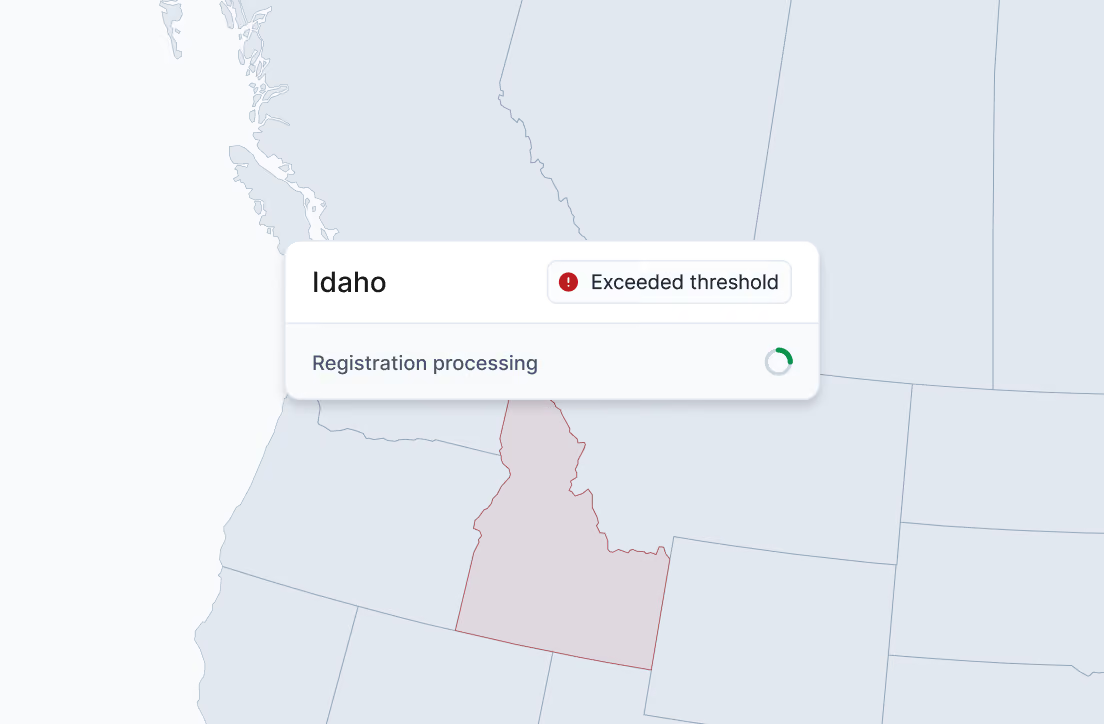
Idaho's economic nexus threshold is $100,000 in sales. Get a free nexus study. All 50 states covered.
Idaho codified affiliate nexus in Idaho Code § 63-3615A, enacted in 2008, which establishes nexus when two conditions are both satisfied. First, the out-of-state retailer and an Idaho-based business must be related parties under IRC §§ 1563, 267, and 318, a standard that generally corresponds to 50% or more common ownership, measured directly, indirectly, or through attribution. Second, the in-state business must either share a substantially similar name, trademark, or trade name with the out-of-state retailer in a way that develops or maintains Idaho sales, or provide services that benefit the out-of-state retailer's Idaho market.
A de minimis exclusion applies: the affiliate nexus provisions do not reach a retailer whose Idaho sales were less than $100,000 in the previous year.
Idaho Code § 63-3611(a)-(f) enumerates the activities that establish physical nexus for a retailer engaged in business in the state. Maintaining an office, warehouse, sales room, sample room, or storage place in Idaho creates nexus, as does maintaining a stock of goods within the state. Renting or leasing tangible personal property to a customer who uses it in Idaho also establishes nexus, as does servicing tangible personal property in the state.
Having at least one employee in Idaho creates nexus, including home-based salespeople. The same applies to a salesman, agent, representative, canvasser, or solicitor operating in Idaho, even if that individual is an independent contractor rather than a direct employee. Delivering goods in vehicles owned, rented, leased, or used by the retailer or related parties independently establishes nexus.
Two additional triggers appear in the statute: a franchisee or licensee operating under the out-of-state retailer's trade name who is themselves required to collect Idaho tax creates nexus for the franchisor or licensor. Multi-level marketing companies also establish nexus through in-state distributors or agents. Inventory stored in an Idaho fulfillment center, including Amazon FBA warehouses, falls under the stock-of-goods and warehouse provisions. Participation in temporary retail events such as fairs and trade shows also creates nexus.
Idaho has no formally published trailing nexus policy. No statute, regulation, or Idaho State Tax Commission guidance document specifies how long collection obligations persist after a seller drops below the threshold or ceases physical presence. An implicit one-year trailing period arises from the current or previous calendar year evaluation language: a business that exceeds $100,000 in the prior year retains its collection obligation for the entirety of the current year, even if sales have since declined. Economic nexus would clearly not apply only after two consecutive calendar years below the threshold.
Lorem ipsum dolor sit amet, consectetur adipiscing elit. Suspendisse varius enim in eros elementum tristique. Duis cursus, mi quis viverra ornare, eros dolor interdum nulla, ut commodo diam libero vitae erat. Aenean faucibus nibh et justo cursus id rutrum lorem imperdiet. Nunc ut sem vitae risus tristique posuere.

