Colorado's economic nexus threshold is $100,000 in sales. Get a free nexus study. All 50 states covered.
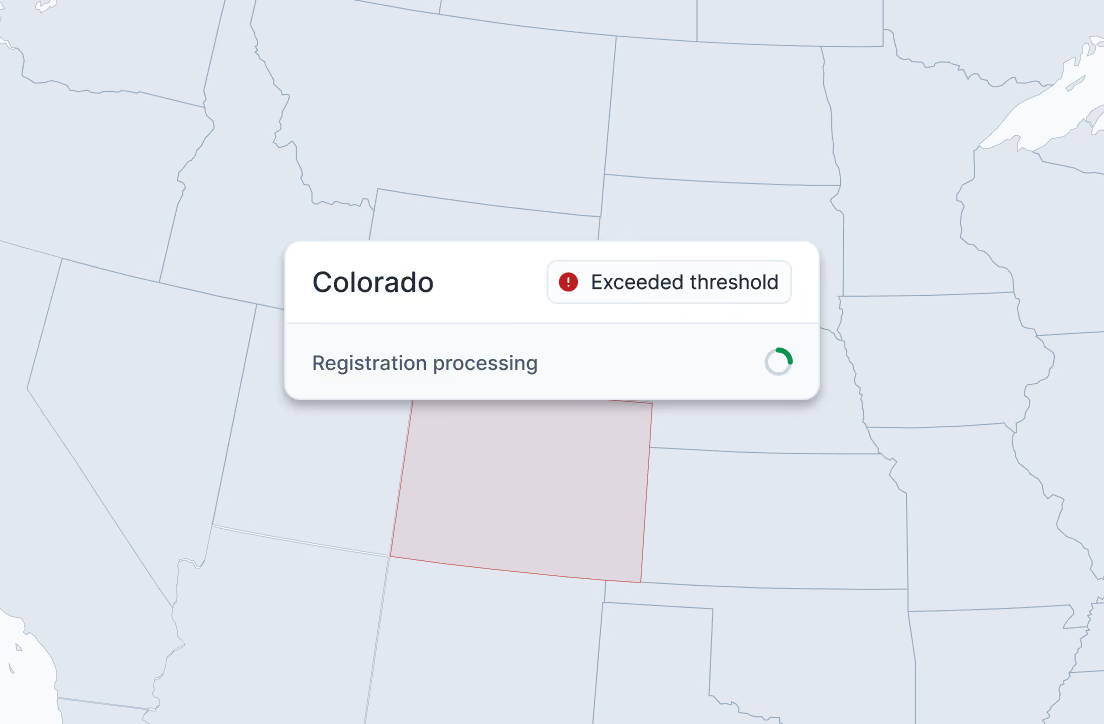
Colorado's affiliate nexus statute establishes nexus when a remote retailer has a direct or indirect ownership interest in, or is owned by, a Colorado-based business, or when a Colorado-based business performs services that are directly related to the remote retailer's ability to establish or maintain a market in Colorado. Qualifying activities include the design or development of tangible personal property sold by the remote retailer, and the solicitation of sales of goods on the remote retailer's behalf by in-state affiliates.
Colorado provides a carve-out for remote retailers whose gross receipts from Colorado customers were less than $50,000 in the prior calendar year. A remote retailer that falls below this threshold does not establish affiliate nexus regardless of whether the in-state affiliate otherwise satisfies the statutory relationship test.
A business establishes physical nexus in Colorado by maintaining any place of business in the state, including an office, distribution center, sales room, warehouse, or storage facility. Inventory stored in a Colorado warehouse on a business's behalf — including merchandise owned by Fulfillment by Amazon sellers and stored in an Amazon-operated Colorado facility — constitutes a taxable presence under the state's doing-business rules.
Temporary in-state activity also creates physical nexus. Attendance at Colorado conventions or trade shows triggers nexus, and sales tax is owed on all orders taken or sales made during such events, even when the business's presence in the state is limited to the duration of a single event.
Colorado does not have a formally codified trailing nexus rule. The state has not enacted a statutory provision extending a collection obligation beyond the period in which the underlying nexus-creating activity occurred. The evaluation period for economic nexus is the current or previous calendar year, meaning that a threshold crossing in a prior year does not automatically extend collection obligations into a subsequent year under a trailing nexus framework.
Lorem ipsum dolor sit amet, consectetur adipiscing elit. Suspendisse varius enim in eros elementum tristique. Duis cursus, mi quis viverra ornare, eros dolor interdum nulla, ut commodo diam libero vitae erat. Aenean faucibus nibh et justo cursus id rutrum lorem imperdiet. Nunc ut sem vitae risus tristique posuere.

